Gemology Course in India: A Complete Career Guide
A gemology course opens the door to the world of gems, diamonds and coloured stones. It teaches you how to identify, grade and value gemstones with confidence. Demand for trained gemologists is rising across the Indian jewellery trade, from retail showrooms to testing labs. This complete guide explains what a gemology course covers, the types available in India, the fees and eligibility, and the careers you can build. It also shows you how to choose the right institute so your time and money deliver real results.
Key Takeaways
- A gemology course trains you to identify, grade and value diamonds and coloured stones for a career in the jewellery trade.
- India offers certificate, diploma and degree routes, with online, offline and hybrid options to suit students and working professionals.
- Choose an institute for hands on lab training, experienced trainers, placement support and a strong alumni network.
What Is a Gemology Course and Who Should Take It
Gemology is the science of studying gemstones. A gemology course teaches you how gems form, how to tell one stone from another, and how to judge quality and value. You work with real stones, a loupe and lab instruments, not just textbooks. To understand the field in more depth, you can read this introduction to gemology and see how the science connects to the jewellery trade. A good course blends theory with daily practical work so you gain skills employers trust from the first week.
Demand for trained gemologists is rising across India. The country cuts and polishes a large share of the world’s diamonds, and its jewellery market keeps growing each year. Shoppers now ask for proof of quality before they buy, so jewellers need staff who can grade and explain stones. A gemology course answers this need. It gives you a skill that showrooms, labs and export houses look for, and it works well in both small family stores and large retail chains.
It also helps to know what gemology is not. Gemology is about the science of stones, their identity, quality and value. It is different from jewellery design or jewellery making, which focus on creating pieces. A gemologist judges and certifies stones, while a designer shapes and sets them. Both roles matter in the trade, but they need different training. If your interest is the stone itself and its value, a gemology course is the right path for you.
What you learn
You learn to identify natural, treated and lab grown stones. You study the properties of diamonds and coloured gems, such as colour, clarity, refractive index and specific gravity. You learn how heat, coating and other treatments change a stone’s value, and how to spot them. You also practise how to explain your findings in simple terms to a customer. These skills sit at the heart of every gemology course, including the programmes IIJF teaches, and prepare you for real trade situations, not just exams.
Who it suits
The entry bar is low, so passion matters more than past marks. If you enjoy detail and want a respected trade skill, gemology is a strong choice. The course suits a wide range of learners:
- School leavers who want a quick, practical route into the jewellery trade.
- Retail and showroom staff who want to advise customers with confidence.
- Family jewellers who want certified knowledge to add to shop experience.
- Career switchers and homemakers looking for a flexible, skilled profession.
Types of Gemology Courses in India
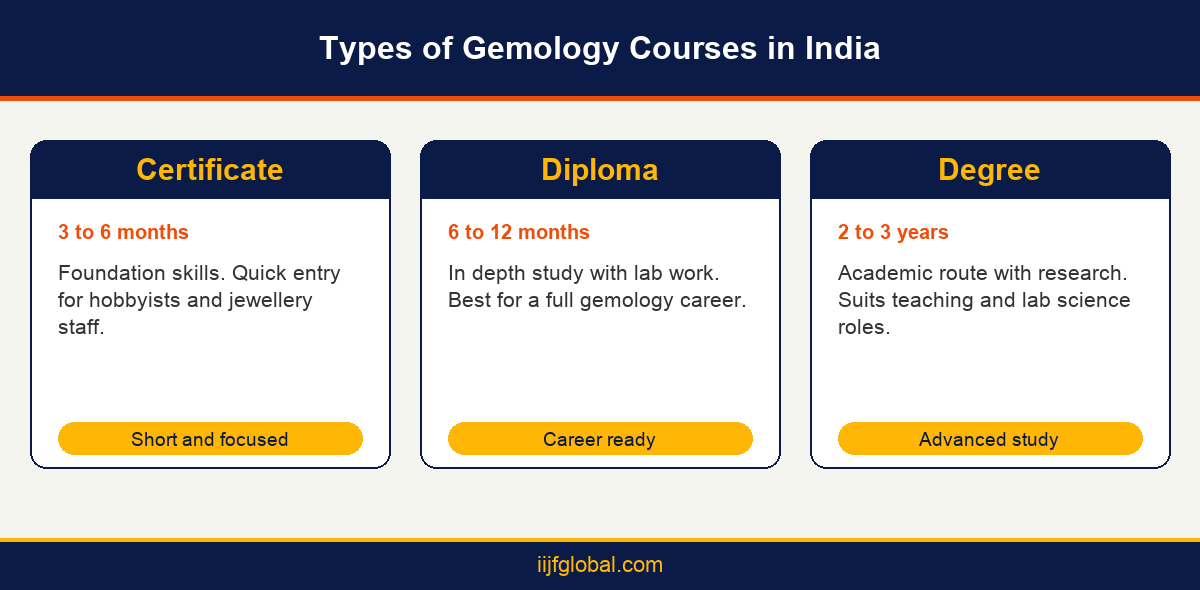
India offers several routes into gemology. The right one depends on your goal, your time and your budget. Some learners want a quick certificate, while others want a full diploma or a degree. Formats also vary, so you can study on campus, online or through a hybrid mix. The comparison below sets out the three main academic routes so you can match a course to your plans.
Certificate, diploma and degree
A certificate is short and covers the basics in three to six months. It suits hobbyists and shop staff who need core skills fast. A diploma runs longer, adds deep lab work and prepares you for a full career. A degree takes two to three years and suits research or teaching roles. Many students pick a diploma because it balances depth with time and leads to strong job outcomes. IIJF’s Diploma in Diamonds and Gemology is one such career focused route that mixes theory with heavy practical training.
Online, offline and hybrid
Online gemology courses let you study theory from anywhere, which helps working professionals and learners in small towns. Offline classes give you hands on lab access and direct trainer support, which builds real confidence. A hybrid model joins both, so you learn theory online and attend campus for practical sessions. Each format has clear trade offs:
- Online: flexible and low cost, but you must arrange your own practice with stones.
- Offline: rich lab time and peer learning, but it needs a fixed schedule and travel.
- Hybrid: theory at home plus campus labs, which suits most working learners.
IIJF Global offers online, offline and hybrid formats, so you can pick the one that fits your life and still get proper lab exposure.
To decide which type fits you, start with your goal and your time. If you only want to serve customers better in a shop, a certificate may be enough. If you want a full career or your own appraisal practice, a diploma is the safer choice. If you plan to teach or work in lab science, a degree suits you best. Match the format to your daily routine as well, since a course you can attend regularly beats a longer one you keep missing.
Gemology Course Syllabus and Skills You Gain
A strong syllabus mixes gem science with daily practice. You move from basic stone properties to advanced identification and grading. The best programmes give you real stones and instruments from week one, not just slides and notes. This builds the confidence you need to work in a lab or a busy showroom. A clear syllabus also shows you how each module links to a real job task.
Core modules
A well planned gemology course usually covers these areas:
- Crystal structure, formation and the physical properties of gems.
- Optical properties such as colour, refractive index and dispersion.
- Coloured stone identification, including rubies, sapphires and emeralds.
- Diamond grading using the four Cs of cut, colour, clarity and carat, the core of a grader’s work.
- Gem treatments, synthetics and simulants, and how to detect them.
- Report writing and how to explain grades to customers.
Together these modules form the base of a trusted gemology career. They also prepare you for a focused gemology certificate or a diploma that employers recognise.
Lab and practical work
Practical work is where skills become real. You use a loupe, microscope, refractometer, polariscope and other tools to test stones. You learn to separate a natural ruby from a synthetic one and to spot a treated diamond. You handle many stones so your eye grows sharp with practice. Hands on hours matter most here, so choose a course that puts you in the lab often, not just in front of slides. The more stones you examine, the more confident and accurate you become.
Good courses also test you the right way. Instead of only written exams, they ask you to identify unknown stones under time pressure, just as you would on the job. This practical testing proves you can perform, not just recall facts. Ask any institute how it assesses students before you enrol. A course that tests real skill gives you a credential that employers can trust.
Gemology Course Fees, Duration and Eligibility in India
Cost and time are common questions for anyone planning a gemology course. Fees in India vary widely by course type and depth. Duration depends on whether you pick a certificate, diploma or degree. Eligibility stays open, which makes gemology accessible to many learners from many backgrounds.
Fees and duration
Across India, short certificate courses often start near thirty thousand rupees. Full diplomas cost more because they include extra lab time, instruments and stone kits. Degrees sit at the higher end due to their length. Duration ranges from a few months for a certificate to two or three years for a degree. Fees are an investment, so weigh them against the lab time, trainer quality and job support you receive. Always ask what the fee includes before you enrol, and confirm whether stones and instruments are provided. As one example, IIJF’s Diploma in Gemology runs for 2.5 months and is listed at Rs 2,25,000.
Eligibility
Most gemology courses ask only for a pass in class ten or class twelve. There is no age limit, so learners from sixteen to sixty join. You do not need a science background to start, since good trainers teach the science from the ground up. A gemology certificate or an IIJF diploma then adds a formal credential to your skills. This open entry is one reason gemology attracts students, jewellers and second career learners alike.
Is it worth the cost
Many learners ask if a gemology course pays back its fee. For most, the answer is yes. A trained gemologist earns more than untrained shop staff and can take on appraisal work that adds income. The skill also stays useful for life, since gems and jewellery remain in demand. A family jeweller who learns grading can protect the business from costly mistakes on stone purchases. When you weigh the fee against these gains, a good course is a sound investment rather than a simple expense.
Career Paths and Salary After a Gemology Course
Gemology leads to varied and stable careers in a growing trade. India remains a global hub for cut diamonds and jewellery, which keeps demand strong. Industry bodies such as the Gem and Jewellery Export Promotion Council report steady activity across the sector. A gemology course places you inside this trade with a skill that jewellers value, and it gives you room to grow into senior roles over time.

Roles you can pursue
A gemology course opens several career doors:
- Certified gemologist in a retail showroom or jewellery brand.
- Diamond grader or gemstone appraiser in a testing lab.
- Quality analyst for a manufacturer or export house.
- Auction house or insurance valuer for high value pieces.
- Trainer, teacher or independent gemology consultant.
If you want to explore one clear route in detail, read this step by step career guide. You can also specialise later as a certified diamond grader, a route we map out separately, to focus on diamonds.
Salary outlook
Pay depends on role, city and experience. Entry level gemologists often start in the range of three to six lakh rupees a year. Skilled appraisers and lab gemologists earn more as trust and experience grow. Trainers and consultants sit at the top of the range because clients pay for proven judgement. Certified skills, a strong portfolio and a good network help you climb faster. As you build a track record, your earning power rises with the value of the stones you handle.
Where the jobs are
Gemology jobs cluster around major trade centres. Mumbai and Surat drive diamond cutting and export. Jaipur is famous for coloured stones. Bangalore, Chennai and other southern cities host large retail chains and growing testing demand. Online gem trade has also opened remote and freelance appraisal work. This spread means you can find roles near home or move to a hub for faster growth. A course based in a trade city, such as Bangalore, gives you early contact with real employers.
Gemologist Certification and Why It Matters
A certificate proves your skill to employers and customers. In a trade built on trust, a respected gemologist certification carries real weight. It tells a jeweller that you can grade stones correctly and spot treatments. It also helps you charge more for appraisal and consulting work. Certification turns your practical learning into a credential the market recognises, and it sets you apart from staff who learned only on the job.
Standards matter here too. Bodies like the Bureau of Indian Standards support quality and hallmarking across the jewellery sector. When your training aligns with trade standards, your certificate means more to an employer. A recognised certification also builds customer trust, since buyers feel safer when a graded stone comes from a trained professional. Always confirm that your institute and its certification are respected within the industry before you enrol, and ask where past students now work.
Certification also comes in levels. A basic certificate shows you know the core skills. A full diploma proves deeper, tested ability across many stone types. Specialist credentials, such as focused diamond grading, mark you as an expert in one area. As you add credentials, you can move into higher paid and more trusted roles. Plan your path so each course builds on the last, rather than repeating skills you already hold.
How to Choose the Right Gemology Institute
The institute you pick shapes your results. Two courses with the same name can differ greatly in lab time, trainers and job support. A wrong choice wastes both money and months, so compare options with care. Use a simple checklist so you weigh each institute fairly. The points below matter most when you judge a gemology course.
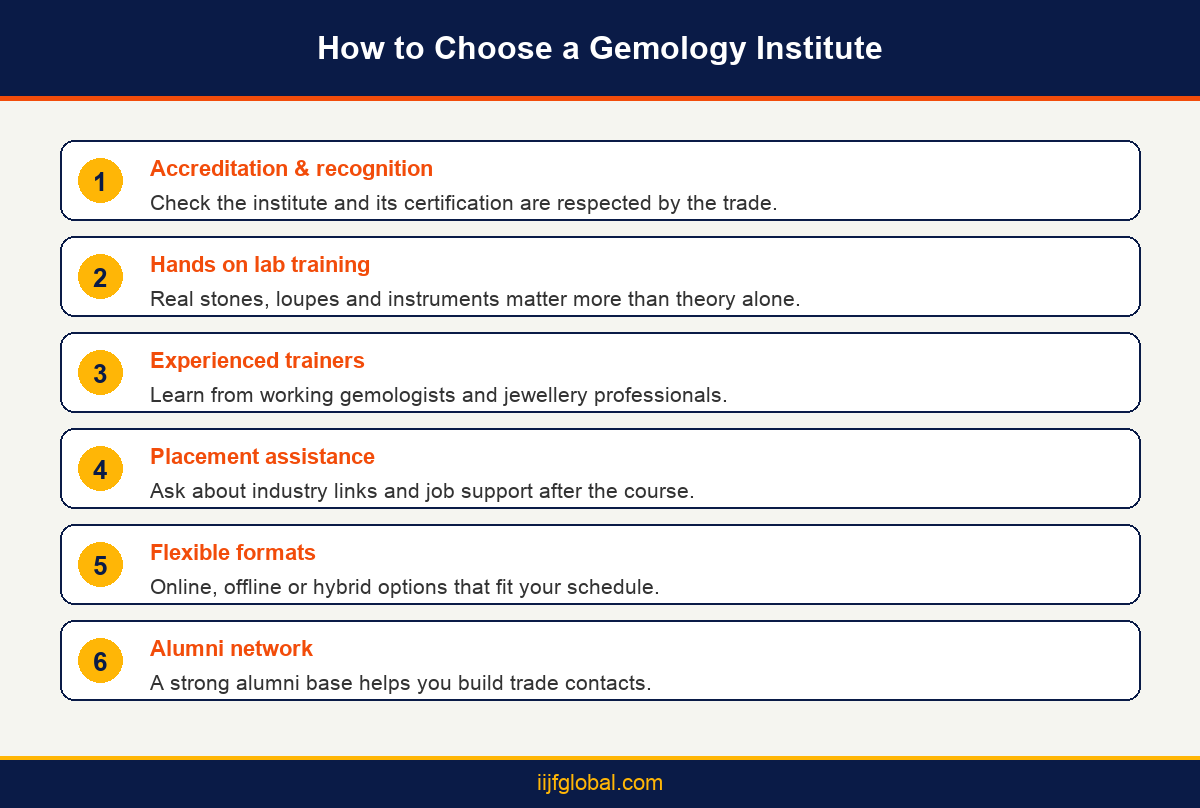
Look for real hands on training, experienced trainers and clear placement help. Check the alumni network, since trade contacts open doors long after the course ends. Confirm the formats on offer so the schedule fits your life. Read reviews and ask to speak with past students where you can. IIJF Global brings these strengths together with expert trainers, practical labs and dedicated placement support, and you can review the full range of courses before you decide.
It also helps to know the warning signs. Be careful of courses that promise a career with no lab time at all. Avoid institutes that will not share who trains you or where past students work. Watch out for very low fees that hide extra charges for stones and instruments. A serious institute is open about its trainers, its labs and its results. When the answers are clear and honest, you can enrol with confidence.
Skills That Set a Great Gemologist Apart
A gemology course gives you the base, but a few habits turn a good gemologist into a trusted one. These skills grow with practice and shape a long career. Employers value them as much as your certificate, because they show you can be relied on with valuable stones.
- A sharp, patient eye that checks every stone with the same care.
- Honest reporting, since trust is the core of the jewellery trade.
- Clear communication that turns technical grades into simple advice.
- Steady hands and method when using delicate lab instruments.
- A habit of learning, because new treatments and synthetics keep appearing.
Build these habits during your course and keep them through your career. They help you earn repeat clients and steady referrals, which matter more than any single sale.
Gemology also rewards those who want to work for themselves. With trusted skills, you can offer appraisal services, advise buyers on high value stones or trade gems on your own account. Many gemologists start part time alongside a job and grow a client base over the years. The freedom to build your own practice is one of the quiet strengths of this profession, and it starts with solid training and an honest reputation.
Study Gemology at IIJF Global in Bangalore
IIJF Global is a gems and jewellery training institute based in Bangalore that has trained more than six thousand students. Its gemology and diamond programmes blend theory with strong lab practice, so you leave with skills you can use from day one. You learn from working gemologists and jewellery professionals, not just lecturers. The institute also offers dedicated placement support through its industry network, which helps you move from classroom to career.
Beyond gemology, IIJF teaches specialised paths that few institutes offer. These include forensic study of jewellery, navratna and astrogemology and jewellery retail sales management. You can start online, on campus or through a hybrid mix, which makes the courses easy to fit around work or study. To learn more about the institute, its trainers and its story, visit the about page.
Conclusion
A gemology course gives you a respected, practical skill in a trade that keeps growing. You learn to identify, grade and value diamonds and coloured stones with confidence. Pick a route that fits your goal, then choose an institute with real lab time, expert trainers and placement support. With the right gemology course, you can build a rewarding career in the jewellery world, whether in a showroom, a lab or your own practice. Explore IIJF Global’s gemology programmes and take the first step today.
Frequently Asked Questions
What is a gemology course?
A gemology course teaches you to identify, grade and value diamonds and coloured stones. You study gem science and use lab tools like loupes and microscopes to test stones with accuracy.
How long does a gemology course take in India?
A gemology certificate takes three to six months. A diploma runs six to twelve months with more lab work. A degree takes two to three years. You can explore all course formats to match your schedule.
What is the eligibility for a gemology course?
Most gemology courses require only a pass in class ten or class twelve. There is no age limit, so students, jewellers and career switchers aged sixteen to sixty can all enrol and learn.
Are online gemology courses worth it?
Online gemology courses are useful for theory and suit working professionals. For full skills you still need lab practice, so a hybrid model that adds campus sessions gives the best results.
What jobs can I get after a gemology course?
Graduates work as gemologists, diamond graders, gemstone appraisers, quality analysts and lab technicians. Some teach or open a consultancy. Retail chains, testing labs and auction houses all hire trained gemologists.
What is the salary of a gemologist in India?
Entry level gemologists often earn three to six lakh rupees a year. Skilled appraisers, lab gemologists and consultants earn more as experience and certification grow. City and role also affect pay.
Is gemologist certification important?
Yes. A respected gemologist certification proves your skill to employers and customers. It builds trust, helps you earn more for appraisal work and sets you apart in a competitive jewellery market.
Which is better, a certificate or a diploma in gemology?
A certificate suits quick learning and hobbyists. A diploma adds deep lab work and prepares you for a full career. Most serious learners choose a diploma for stronger job outcomes.
Does a gemology course include diamond grading?
Yes. A good gemology syllabus includes diamond grading using the four Cs. You can also follow a focused career route to specialise further in diamonds.
Where can I study gemology in Bangalore?
IIJF Global in Bangalore offers gemology, diamond grading and specialised courses with hands on labs, expert trainers and placement support. Online, offline and hybrid formats are available for all learners.

You may also like

Jewellery CAD Design Course: Skills, Software and Scope

Gemology Course Fees, Duration and Eligibility in India
