What Is Jewelry Forensics? A Complete Career Guide & How to Get Certified in India
Every year, lakhs of buyers spend their savings on gold and diamond jewellery they cannot independently verify. Jewelry forensics is the professional skill of examining, authenticating, and grading that jewellery scientifically — and it is fast becoming one of the most valuable specialisations in the gems and jewellery industry.
If you have ever wondered how an expert can tell real gold from clever imitation, spot an under-karated piece, read a hallmark, or interpret a diamond certificate with confidence, you are already thinking like a jewelry forensics professional. This guide explains what jewelry forensics actually is, why demand for it is growing in India, what you learn in a professional course, and how to turn that knowledge into a career or a stronger business.
What Is Jewelry Forensics?
Jewelry forensics is the systematic, scientific examination of jewellery to assess its authenticity, composition, quality, and value. Rather than relying on trust or guesswork, a jewelry forensics professional uses defined processes and tools to answer questions such as:
- Is this metal genuinely gold, and what is its true purity (karatage)?
- Is the hallmark valid, and what does the HUID code actually certify?
- Has the piece been plated, coated, or treated to hide a cheaper base metal?
- Are the stones natural, synthetic, or imitation — and are the settings sound?
- Does the jewellery certificate or report match the physical product?
In short, jewelry forensics is where craftsmanship meets quality control. It blends knowledge of precious metals, manufacturing, hallmarking standards, gemstone basics, and certificate interpretation into a single practical discipline — the ability to look at any piece of jewellery and read the truth about it.
Jewelry Forensics vs Gemology — What’s the Difference?
Gemology focuses primarily on identifying and grading gemstones and diamonds. Jewelry forensics is broader: it covers the entire finished piece — the metal, its purity and hallmarking, the manufacturing quality, the settings, the plating, and how to interpret the accompanying certificates.
A gemologist evaluates the stone; a jewelry forensics professional evaluates the whole product.
Why Is Jewelry Forensics in High Demand Right Now?
Several forces are converging to make jewelry forensics one of the most relevant skills in the industry today:
1. Mandatory hallmarking has raised the stakes
With BIS hallmarking and the six-digit HUID (Hallmark Unique Identification) now central to gold sales in India, every retailer, manufacturer, and serious buyer needs people who genuinely understand karatage, hallmarking standards, and compliance. Misreading a hallmark is no longer a small mistake — it is a legal and financial risk.
2. Buyers are more aware and more demanding
Today’s customers ask for certificates, purity proof, and scientific backing before they buy. Showrooms that can confidently explain and verify what they sell win trust; those that cannot, lose it. Trained staff who understand jewelry forensics directly protect a brand’s reputation.
3. Treatments and imitations are increasingly sophisticated
From electroplated pieces passed off as solid gold to lab-grown stones presented as natural, the techniques used to disguise lower-value jewellery are advancing quickly. Only trained eyes, supported by the right process, can reliably tell the difference.
4. The industry is large — and growing
India is one of the world’s largest gold and jewellery markets, and the global gems and jewellery sector continues to expand. Every link in that chain — retail, manufacturing, appraisal, insurance, pawnbroking, and resale — needs people who can assess quality objectively. That is the gap jewelry forensics fills.
What You Learn in a Jewelry Forensics Course
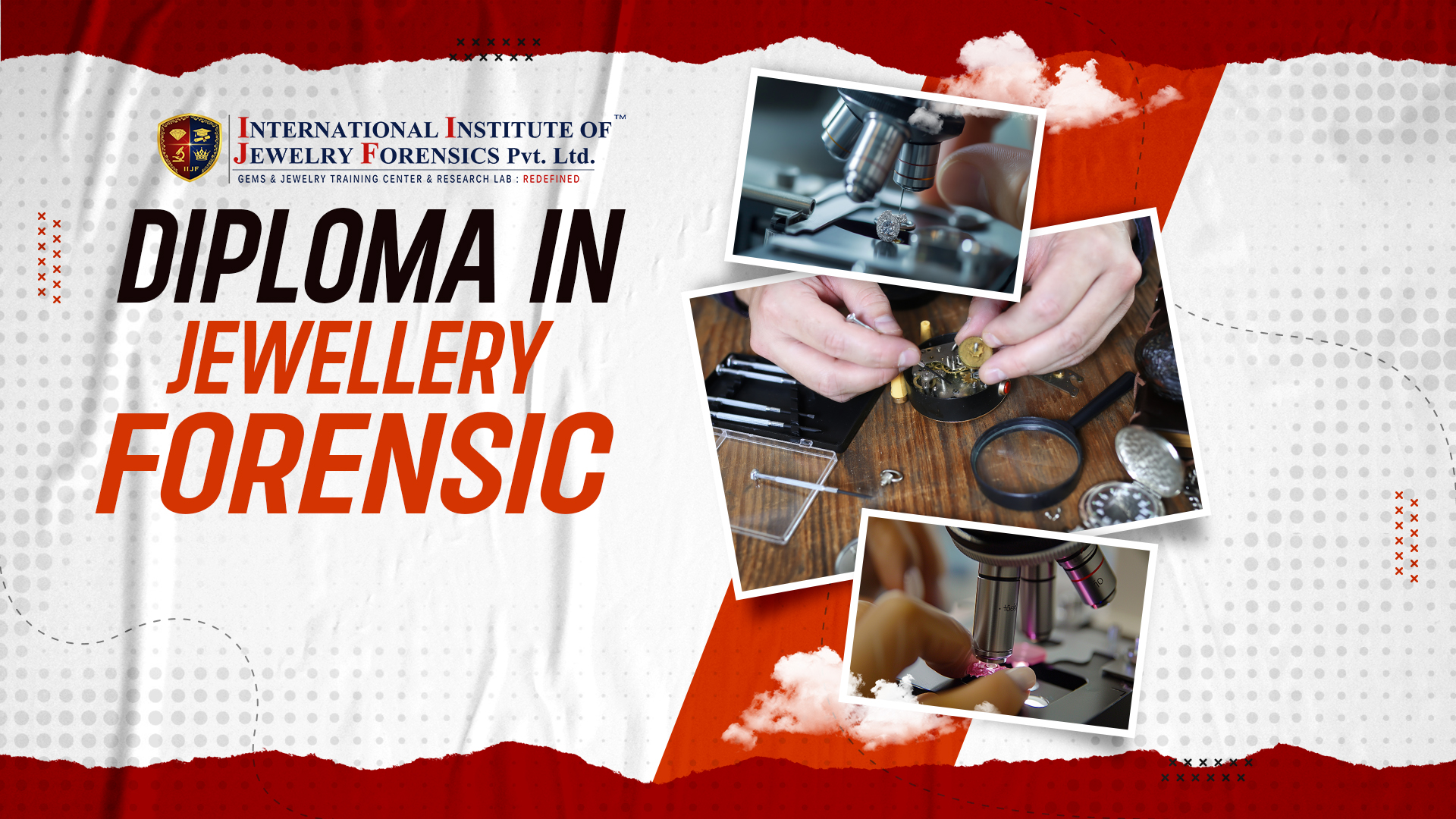
A well-designed jewelry forensics programme does not stop at theory — it builds the practical ability to assess a real piece of jewellery end to end. Here is what IIJF Global’s Diploma in Jewelry Forensics covers:
| Module Area | What You Master |
| Precious Metals | Gold, silver, and platinum in detail; the basics of rhodium and palladium; how precious metals are formed and mined. |
| Metal Refining & Purity | Refining processes and gold purity compositions — 9Kt, 12Kt, 14Kt, 18Kt, 22Kt and more — plus gold colours such as rose, white, and black gold. |
| Hallmarking Standards | HUID, BIS, and karatage standards — what they mean, how to read them, and how to verify them. |
| Finishes & Coatings | Metal polishes and finishes; electroplating and coating on metals, and how to detect them. |
| Jewellery Construction | Types of stone settings; categories and regional types of jewellery; the manufacturing journey from sketch to final product. |
| Stones — The Basics | Foundational knowledge of diamonds and gemstones as they relate to finished jewellery. |
| Quality Control & Grading | Metal QC and jewellery grading techniques used to assess overall quality. |
| Certificate Interpretation | How to read and interpret jewellery certificates and lab reports — and match them against the physical piece. |
Course Snapshot — Diploma in Jewelry Forensics
- Duration: 10 days (10 hours of theory — 1 hour/day, online)
- Format: Fully online, with optional factory & diamond market visits
- Languages: English, Malayalam, Tamil, Hindi, Kannada, Telugu
- Level: All levels — no prior background required
Certification: Diploma from IIJF + Accredited Course Completion Certificate from HRDS + Mark List from the Board of Examinations, HRDS
Who Should Take a Jewelry Forensics Course?
This course is designed for anyone who deals with jewellery and wants the confidence to assess it properly:
- Jewellery retail & sales professionals who want to advise customers credibly and protect their showroom’s reputation.
- Jewellery business owners who need to verify stock, manage quality, and buy with confidence.
- Aspiring appraisers and valuers building toward a career in jewellery assessment.
- Pawnbrokers, gold-loan, and intake specialists who must evaluate pieces quickly and accurately.
- Goldsmiths and bench jewellers wanting to formalise and certify their practical knowledge.
- Newcomers to the industry who want a fast, practical entry point — no prior experience needed.
Career Paths After a Jewelry Forensics Course
Once you can assess jewellery scientifically, several roles open up across the industry:
- Jewellery Quality Control (QC) Executive — verifying metal purity and finished-product quality for manufacturers and retailers.
- Jewellery Appraiser / Valuer — assessing pieces for sale, insurance, or resale value.
- Retail Product Expert — the in-showroom authority customers and staff rely on (a role that commands a salary premium).
- Hallmarking & Compliance Assistant — supporting BIS/HUID compliance in retail and manufacturing.
- Procurement & Sourcing Specialist — buying stock with verified quality for a jewellery business.
- Independent Consultant — offering verification and advisory services, in India or abroad.
Why “India’s First” Matters Here
While global institutions offer short jewelry forensics seminars, a dedicated, certified Diploma in Jewelry Forensics remains rare — especially in India. IIJF Global was founded specifically around this discipline, which means the subject is taught not as an add-on, but as a complete, structured profession with certification, placement assistance, and industry exposure.
What Makes IIJF’s Jewelry Forensics Course Different?
- Triple certification — Diploma from IIJF, Accredited Course Completion Certificate from HRDS, and an official Mark List from the Board of Examinations, HRDS.
- Taught by certified industry experts — led by GIA- and IGI-credentialed professionals with real trade experience.
- Flexible online format in six languages, so you can learn from anywhere in India.
- Lifetime IIJF Alumni Club membership and 100% job placement assistance in India and abroad.
- Embassy attestation support for those seeking jobs overseas.
- End-to-end procurement assistance for students who run or plan to start a jewellery business.
- Optional factory and diamond market visits for hands-on industry exposure.
Frequently Asked Questions
What is jewelry forensics in simple terms?
It is the scientific examination of jewellery to confirm what it really is — its metal, purity, hallmark, quality, and stones — rather than relying on trust. It is essentially quality control and authentication for finished jewellery.
Do I need a background in gemology or jewellery to join?
No. The Diploma in Jewelry Forensics is designed for all levels and starts from the fundamentals, so beginners and working professionals alike can follow it.
How long is the jewelry forensics course?
The IIJF programme runs over 10 days, with 10 hours of theory delivered online at one hour per day. Optional factory and market visits are available for additional hands-on exposure.
Is the course available online across India?
Yes. It is offered fully online in English, Malayalam, Tamil, Hindi, Kannada, and Telugu, so you can join from anywhere in the country.
What certificate will I receive?
You receive a Diploma Certificate from IIJF, an Accredited Course Completion Certificate from HRDS, and a Mark List from the Board of Examinations, HRDS.
Ready to Become a Jewelry Forensics Professional?
Join IIJF Global’s certified Diploma in Jewelry Forensics and learn to assess any piece of jewellery with confidence.
Call / WhatsApp: +91 9000 638 438 | +91 75 61 88 11 20
Email: info@iijfglobal.com