
Diamond Grading Course: Syllabus, Practical Hours and Skills
Most people choosing a diamond grading course compare the fee and the duration, then stop. The module list tells you far more, because it shows what you should be able to do at the end. This guide walks through the sixteen modules published for IIJF’s one-month grading diploma, from how diamonds form to how they are priced. Use it as a yardstick for any syllabus you are comparing. It covers the syllabus only. For the career side, read our companion guide to entering the profession.
Key Takeaways
- A complete diamond grading course moves from formation and tools through the 4Cs to plotting, lab grown stones, reports and pricing.
- IIJF’s Diploma in Diamond Grading publishes 20 hours of theory online and 20 hours of practicals offline.
- Use the module list to ask each institute how much diamond grading practical training sits behind every topic.
Diamond Grading Course Syllabus: The Modules From Formation to Market Pricing
In short: a complete diamond grading course starts with how a diamond forms and ends with how it is bought and sold. IIJF’s course page lists sixteen modules along that route. Read any syllabus the same way, checking that each stage appears, because a missing stage may mean a skill you must learn later.
The first three modules build the base: formation and crystallography, mine to market processes, and grading tools and equipment. Next come the four grading factors, listed as clarity, colour, cut and carat weight estimation. If you need a refresher, see our plain explanation of cut, colour, clarity and carat. The list then moves to diamond plotting and fancy shapes. The later modules turn outward: treatments, lab grown stones, simulants, labs and report interpretation. It closes with Rapaport and market pricing, the basics of trading, and grading mounted diamonds.

The hours matter as much as the topics. IIJF’s Diploma in Diamond Grading runs for one month, at a listed fee of Rs 1,50,000 against a list price of Rs 2,00,000. It has 20 hours of theory, taught online for one hour a day over 20 days. It also has 20 hours of practicals, held offline for two hours a day over 10 days. That averages two and a half hours per module, though the page does not publish how the hours are divided. So ask every institute for its split, and ask which modules receive diamond grading practical training.
Colour Grading With a Master Set: What Practice Looks Like
In short: colour grading means comparing a diamond against reference stones of known grade, rather than judging it from memory. IIJF’s module names a master set, which is the detail to look for in any syllabus. Without reference stones, a student can learn the scale but cannot test an eye against it.
A master set is a group of stones whose colour grades are already established. You place the diamond being graded beside them and decide where it falls on the letter scale for near colourless stones. The differences between neighbouring grades are slight, so judgement builds through repetition and correction. Practice also depends on consistent conditions. Graders usually view stones against a neutral white background under controlled light, because a stray tint from a wall or lamp can mislead the eye. Size and shape affect how colour reads as well, so one or two examples will not train you.
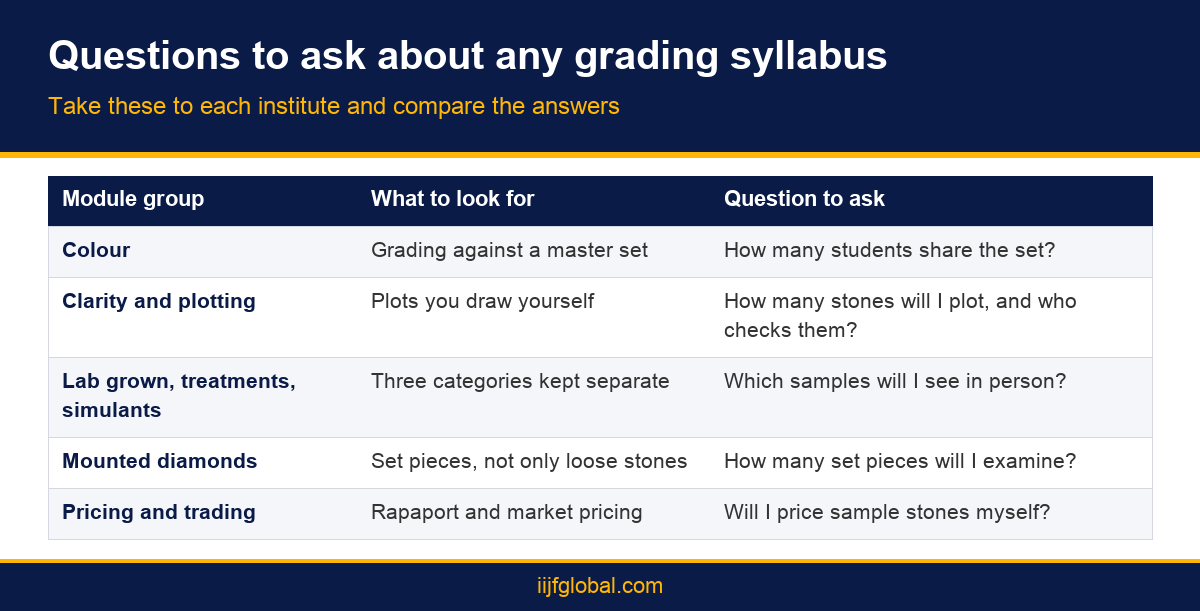
IIJF’s page does not describe how this module runs in the room, so treat these as questions for any diamond grading course. Who owns the master set, and are its stones natural diamonds or substitutes? How many students share it at once? Will you grade unknown stones and compare your answers with a trainer’s? Will you cover fancy shapes as well as round stones? The answers separate a demonstration from real diamond grading practical training. If an institute cannot answer clearly, note that when you compare it with other options.
Plotting and Clarity: Why These Modules Take Time
In short: clarity grading asks you to find every inclusion and blemish, judge its effect, and record it. Plotting turns that search into a drawn map of the stone. Both skills depend on slow, careful looking, so they reward hours at the bench far more than hours spent reading slides or lecture notes.
IIJF lists clarity as a module on inclusions and blemishes, and diamond plotting as a separate one. Inclusions sit inside the stone, while blemishes sit on its surface. A beginner’s first difficulty is simply finding them. A speck may turn out to be dust, or the reflection of a single inclusion repeated across several facets. Learning those differences takes repeated viewing through magnification, with someone to correct you. Any diamond grading course should explain its instruments early, and our guide to the instruments used in gem testing gives you a useful head start.
Plotting adds a second skill. You mark the type and position of each feature on a diagram of the stone’s crown and pavilion, using agreed symbols. A finished plot works like a fingerprint, helping to identify that particular stone later. It also forces precision, because you cannot draw what you have not clearly seen. Ask how many stones you will plot yourself, whether a trainer checks each plot, and whether fancy shapes are included. A diamond grading course that shows plotting only as a diagram on a slide leaves this skill untrained.
Lab Grown Diamonds, Treatments and Simulants on the Syllabus
In short: three modules teach you what a stone might be, other than an untreated natural diamond. Treatments cover natural diamonds that were altered. Lab grown covers real diamond made in a laboratory by HPHT and CVD. Simulants cover other materials that only look like diamond. A current syllabus should keep these three clearly separate.
The distinction matters because each category raises a different question at the counter. HPHT recreates high pressure and temperature, while CVD builds carbon up from a gas. The result is diamond by chemistry, so simple checks aimed at imitations may not separate it. Simulants such as cubic zirconia and moissanite are different materials altogether. Treatments such as laser drilling and fracture filling change how clarity appears. To see how these differences come up in practice, read how showroom staff can answer these questions.
Compare each diamond grading course on what you will do in these modules. Will you see lab grown, treated and simulant samples in person? Will the trainer show what screening instruments can and cannot confirm? Do they explain when a stone must go to a laboratory? Also ask how this work connects with reports, since IIJF lists labs and report interpretation straight after simulants. A grader who reads reports well can check what they state about origin and treatment. Our wider guide to grades, reports and certificates shows how those pieces fit together.
Mounted Diamonds, Pricing and the Basics of Trading
In short: the final modules take grading away from the ideal conditions of a loose stone. Mounted diamonds limit what you can see and measure. Rapaport and market pricing connect a grade to a price. Trading basics add buying and selling. These are skills that family jewellers and showroom staff can apply at work.
A mounted stone hides parts of itself. Prongs and metal can cover inclusions, and the setting can block your view of the pavilion. Metal can also reflect colour into the stone. You cannot weigh a set diamond directly, so carat has to be estimated from measurements. IIJF titles this module the basics of grading mounted diamonds, so a diamond grading course of this length is best read as an introduction to the skill. Ask any institute how many set pieces you will examine, and whether they include different setting styles. Then ask how a grader words a result when part of the stone cannot be seen.
Pricing comes late in the list for good reason, because a price means little until you can defend the grade behind it. Rapaport is a widely used trade price reference, and market pricing looks at how real deals differ from a list. IIJF pairs these with the basics of buying and selling. Ask whether you will price sample stones yourself, or only see the list explained. Ask too whether a diamond grading course uses current prices in class. Trading basics will not make you a dealer in a month, but they help you follow the trade’s language.
Conclusion
A good diamond grading course is easy to recognise once you read its syllabus closely. The module list shows whether it runs from formation through to pricing. The published hours show how much time sits behind those skills. Take the questions in this guide to every institute you are considering, and compare the answers side by side. Then review the full module list on IIJF’s course page against them. When you are ready, speak to the IIJF team about current batches, practical sessions and how the hours are divided.
Frequently Asked Questions
What is taught in a diamond grading course?
A full course covers formation, mining, tools, the four grading factors, plotting, fancy shapes, treatments, lab grown stones, simulants, reports, pricing, trading and mounted stones. IIJF’s course page lists these as sixteen modules, which makes a useful comparison list.
How long is IIJF’s diamond grading course?
IIJF’s Diploma in Diamond Grading lists one month. That covers 20 hours of theory, online for one hour a day over 20 days, and 20 hours of practicals, offline for two hours a day over 10 days.
What does IIJF charge for this course?
The course page lists the Diploma in Diamond Grading at Rs 1,50,000, against a list price of Rs 2,00,000. Fees can change, so confirm the current amount, and what it includes, with the IIJF team before you enrol.
What is diamond grading practical training?
It is supervised time spent grading real stones, rather than hearing about grading. Ask how many stones you will handle, whether a master set is available, and who checks your answers. Compare the practical hours as well as the total course hours.
Why do plotting and clarity take so long to learn?
You must learn to find small features, tell inclusions from blemishes and dust, then record each one accurately. That skill comes from repeated viewing with correction from a trainer, so it rarely develops from theory sessions or slides alone.
Should a grading syllabus cover lab grown diamonds?
Yes, because graders need to recognise lab grown stones and report on them accurately. Look for modules on HPHT and CVD growth, treatments and simulants. Also ask which samples you will see, and when a stone needs laboratory testing.
What do students receive after the IIJF course?
Students earn a Diploma Certificate from IIJF, an Accredited Course Completion Certificate from HRDS, and a Mark List from the Board of Examinations, HRDS. Certificates can then be checked on IIJF’s page for verifying certificates.
How does grading differ from a broader gem diploma?
Grading focuses on diamonds alone, from the 4Cs to plotting and market pricing. IIJF’s 2.5-month gem diploma covers precious, semi precious and organic gems, with identification procedures, treatments, synthetics and origin determination. Choose based on the stones you expect to handle.
Can this skill be learned entirely online?
Colour comparison and plotting depend on handling stones, so ask any fully online course how it trains those skills. IIJF’s grading diploma teaches theory online and holds its 20 practical hours offline, which is the split to compare against.

You may also like

Jewellery CAD Design Course: Skills, Software and Scope

Gemology Course Fees, Duration and Eligibility in India
