Certified Gemology Training Institute: How to Choose One
A certified gemology training institute should be able to prove every claim on its brochure. Most learners in India reach one decision early: an international programme or an Indian diploma. Both routes can work, and the right one depends on your budget, your time and the job you want. This guide leaves institute names aside and gives you the tests instead. You will learn what certified and accredited mean, how to verify paperwork and why practical hours matter most. IIJF Global in Bengaluru trains gem professionals, and you can apply these tests to us too.
Key Takeaways
- A certified gemology training institute should name who reviews it, who sets its exams and how an employer can verify your certificate.
- International programme or Indian diploma is a decision about total cost, time away and the work you want next.
- Before you join an accredited gemology diploma program in Bengaluru, get the practical hours in writing, because they predict bench skill better than course length.
What Certified and Accredited Actually Mean
In short: certified usually means a course issues a certificate. Accredited means an outside body has reviewed something about that course or provider. The two words are not interchangeable. Before you trust either one, find out who gave the approval, what exactly was reviewed, and whether you can check the answer without the institute’s help.
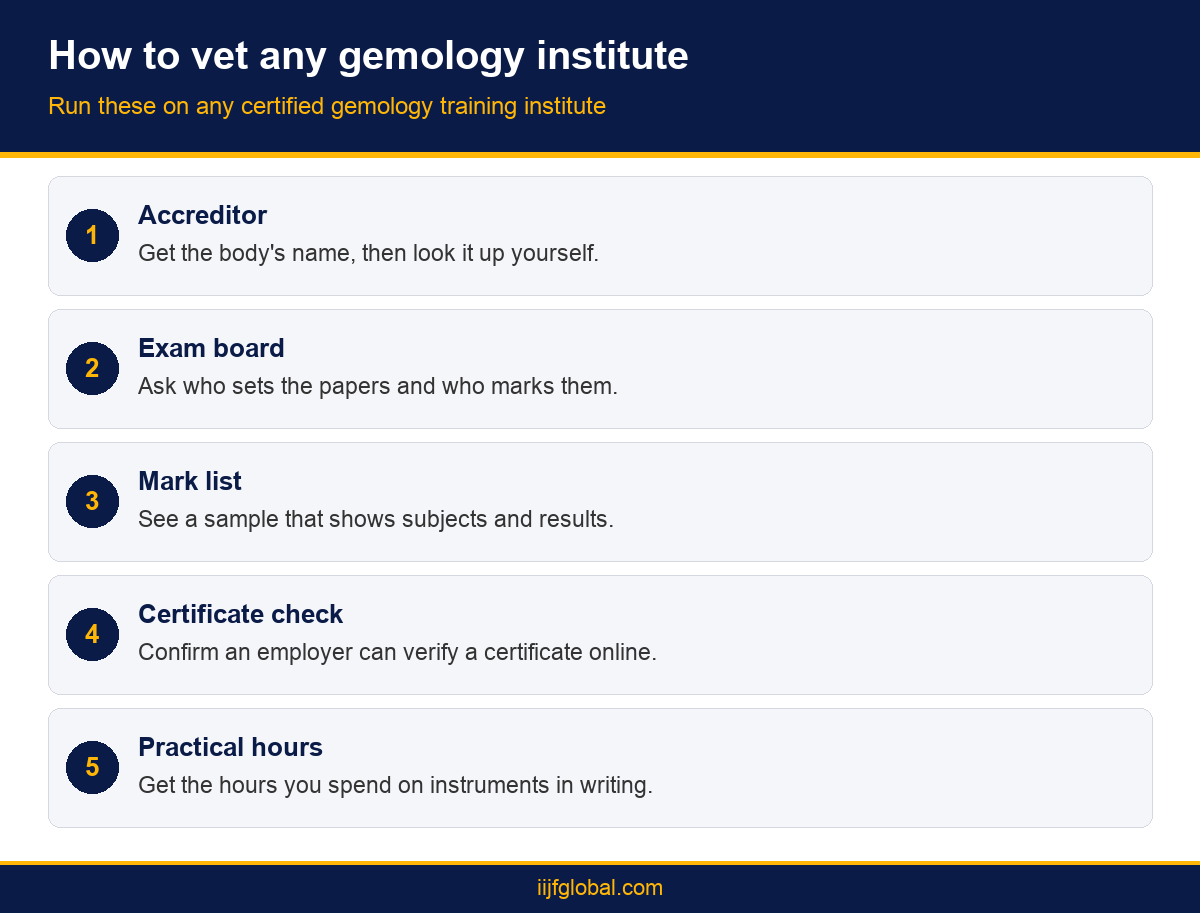
Start with the word certified. Any provider can print a certificate, so the word alone proves little. A certified gemology training institute earns trust when its certificate has something behind it: a defined syllabus, a set assessment and a record others can check. Accreditation is a different idea. Read what accreditation generally involves: a third party assesses a provider or programme against a stated standard. Ask for the accrediting body’s name, then look that body up yourself. Read what it covers, because approval of one course says nothing about the rest of a catalogue.
Next, separate a skill credential from a university qualification. Private gem diplomas are usually professional credentials, and they can carry real value in trade work. A degree is a different thing. If a provider uses the word degree, check its university link against the University Grants Commission website. An accredited gemology diploma program in Bengaluru should be able to tell you in one sentence which body reviews it and what that review covers. If the answer stays vague, treat the claim as marketing until you see the document.
International Programme or Indian Diploma: Cost, Duration and Travel
In short: an international programme can suit someone planning to work or study abroad. An Indian diploma can suit someone who wants trade skills close to home, in a shorter window. Compare the full cost, the months away from work and the travel involved, then match the result to the job you want next.
Cost is where headline fees mislead. For an international programme, add currency conversion, flights, visas, rent, kit and exam charges. Ask any certified gemology training institute, at home or abroad, for a written total in rupees. Indian diplomas are simpler to price, though you should still ask what the fee includes. As a published example, the IIJF Diploma in Gemology is listed at Rs 2,25,000 against a list price of Rs 3,00,000. The one-month grading diploma at IIJF is listed at Rs 1,50,000 against Rs 2,00,000. Confirm current fees before you enrol.
Duration and travel decide whether a plan survives real life. Residential study abroad can mean leaving your job or the family shop for an extended period. Online theory with short offline blocks asks for less time away, though practicals still need you in the room. The IIJF gemology diploma runs 2.5 months: one hour a day online for 60 days, then three hours a day offline for 15 days. Ask where practicals happen, and price your travel and stay for those days. Then ask employers in your target market which credentials they shortlist, since recognition varies by country and by trade.

Exam Boards, Mark Lists and Certificate Verification
In short: a credential is only as strong as the paperwork behind it. Find out who sets and marks the exam, what the mark list shows and how a stranger can confirm your certificate. A certified gemology training institute should answer all three questions quickly, in writing, and before you pay a deposit.
Begin with the exam. Ask who sets the papers, who marks them and who can fail you. An exam with a named board behind it is easier for an outsider to trust than one known only to the classroom. Request a sample mark list too. It should show the subjects assessed and your results, which tells an employer more than a certificate alone. At IIJF, students earn a Diploma Certificate from IIJF, an Accredited Course Completion Certificate from HRDS and a Mark List from the Board of Examinations, HRDS. Look up any board you are given, ours included.
Then test verification. A future employer should be able to confirm your certificate without calling your teacher. IIJF provides a public page for checking its course certificates, and any certified gemology training institute should offer you an equivalent. Try it before you enrol. Ask what details a search needs, what result it returns and how long records stay available. Do not confuse this with a stone report. A gem report describes a stone, while a course certificate describes a person. Employers will care about the second one when they read your CV.
Why a Certified Gemology Training Institute Must Publish Practical Hours
In short: practical hours are the number that matters most. Gemology is a bench skill, and you build it by handling stones and instruments under supervision. Theory can be learned from many sources. Supervised time cannot. Ask for hours rather than months, and ask how many of those hours you personally spend on the instruments.
Course length hides a lot. A long course with little lab time can teach less at the bench than a shorter one built around it. Convert the schedule of every certified gemology training institute on your list into theory hours and practical hours. IIJF publishes its split, so use it as a reference point. The gemology diploma lists 60 hours of theory and 45 of practicals, while the grading diploma lists 20 of each. That makes about 43 and 50 per cent practical time. Other courses may run higher or lower. What matters is that you have the figure.
Then ask what fills those hours. Who supervises, how many students share one instrument, and how many stones will you handle yourself? A refractometer, polariscope, microscope and loupe all take repetition, and what each instrument does at the bench is worth reading before you visit. Ask to see the lab and the teaching stones. Check that the set includes treated stones, synthetics and simulants, since those are the calls that cost money in trade. A certified gemology training institute that welcomes these questions is showing you how it teaches.
A Comparison Table to Fill In for Any Institute
In short: write every option into one table before you decide. Copy the rows below, add a column per institute, and leave a blank wherever the answer was vague. An accredited gemology diploma program in Bengaluru and an international programme can then be judged on identical questions, and the blanks show you where to press further.
| Check | Question to ask | Institute A | Institute B |
|---|---|---|---|
| Accreditor | Which body reviewed you, and what did it review? | ||
| Exam board | Who sets and marks the exam? | ||
| Mark list | Can I see a sample before paying? | ||
| Verification | Can an employer check my certificate online? | ||
| Total cost | What is the written total, with travel and stay? | ||
| Duration | How many months, and how many days in person? | ||
| Theory hours | How many hours are taught, and in what format? | ||
| Practical hours | How many hours do I spend on instruments? | ||
| Support | What placement assistance is offered, in writing? |
Ask for the answers by email, so you keep a record. A certified gemology training institute with clear answers can fill most of this table in one reply. Treat placement carefully: ask what the assistance involves, and walk away from anyone promising a job. Check the teaching language as well. IIJF lists English, Malayalam, Tamil, Hindi, Kannada and Telugu.
Conclusion
The right certified gemology training institute is the one whose claims survive checking. Decide first between an international programme and an Indian diploma, based on total cost, time away and the work you want next. Then verify the accreditor, the exam board, the mark list and the certificate page. Fill in the table, and weigh practical hours above everything else. If an accredited gemology diploma program in Bengaluru is on your shortlist, speak to the IIJF team with your completed table. Ask for our hours, papers and current batch dates, and hold us to the same tests.
Frequently Asked Questions
How do I check a certified gemology training institute before paying?
Ask who accredits it, who sets the exams and how employers verify its certificates. Then confirm each answer yourself on the named body’s own website. Request a sample mark list and the written practical hours before you pay any deposit.
What is the difference between certified and accredited?
Certified usually means the course issues a certificate when you finish. Accredited means an outside body has reviewed the provider or programme against a stated standard. Ask which one applies, who did the review and what exactly that review covered.
Is an international programme better than an Indian diploma?
Neither is better for everyone. An international programme can suit work or study abroad, if employers there recognise it. An Indian diploma can suit trade work closer to home, with less time away. Compare total cost, practical hours and your next job.
How many practical hours should a gemology diploma include?
No single figure fits every course, so compare hours across your shortlist. As a published reference, the IIJF gemology diploma lists 45 practical hours and 60 theory hours. Ask how many of those hours you personally spend handling stones and instruments.
Can gemology be learned fully online?
Theory travels well online, but instrument work and stone handling need supervised practice in person. Read what can and cannot be learned remotely before choosing a format, and ask any provider exactly how it delivers and assesses practical hours.
What should a mark list show?
It should name the issuing board, the subjects assessed and your results. That gives an employer more detail than a certificate alone. Ask for a sample before you enrol. At IIJF, the mark list comes from the Board of Examinations, HRDS.
How long does a gemology diploma take in India?
Durations vary by provider, so check the hours as well as the months. The IIJF gemology diploma runs 2.5 months and its grading diploma runs one month, with theory online and practicals offline. Confirm the schedule before planning leave or travel.
Does a diploma guarantee a job?
No honest provider can guarantee a job. IIJF lists placement assistance in India and abroad, which is help with the search and not a promise. Read about the steps into the profession and ask what support means in practice.
What is the difference between a course certificate and a gem report?
A course certificate records that a person completed training. A gem report describes one stone, usually issued by a laboratory. Employers read the first when they hire you, while buyers read the second when they purchase a stone. Verify each one separately.

You may also like

Jewellery CAD Design Course: Skills, Software and Scope

Gemology Course Fees, Duration and Eligibility in India
