Gemology Course Fees, Duration and Eligibility in India
Fees, duration and eligibility are the first questions most learners ask about a gemology course or a gemology certificate. The good news is that gemology stays open to many people, with routes to fit most budgets and schedules. This guide breaks down what a gemology course costs in India, how long each route takes, and who can join. It also weighs whether the fee is worth the return.
Key Takeaways
- Gemology course fees in India range widely, from short certificate fees to higher diploma and degree costs.
- Duration runs from a few months for a certificate to two or three years for a degree.
- Most courses need only a class ten or class twelve pass, with no age limit.
How Much Does a Gemology Course Cost in India
Gemology course fees in India depend on the course type, its depth and the lab time included. Short certificate courses often start near thirty thousand rupees. Full diplomas cost more because they add lab hours, instruments and stone kits. Degrees sit at the higher end due to their length. Always check what the fee covers before you enrol, since stones and instruments can add to the total. You can review the gemology and diamond programmes to see how a career focused course is structured.
Location and reputation also shape the price. Courses in major trade cities may cost a little more, but they often bring better labs and stronger placement links. A low fee can hide extra charges, so ask for the full cost in writing. Compare two or three institutes on value, not just the headline price. Weigh the fee against the lab time, trainer quality and job support you receive, since these decide the real return on your money.
How Long Does a Gemology Course Take
Duration depends on the route you pick. A certificate takes three to six months and covers the basics. A diploma often runs six to twelve months and adds deep lab work for a full career, though formats vary: IIJF’s Diploma in Gemology takes 2.5 months and is listed at Rs 2,25,000. A degree takes two to three years and suits research or teaching. Part time and hybrid options can spread study across a longer period, which helps working learners. Pick a length that matches your goal, then confirm the weekly time the course expects from you before you commit.
Think about your own routine before you choose a length. A short certificate suits someone who needs skills fast, such as a jeweller who wants to grade stones for the shop. A longer diploma suits a learner who wants a full career and deeper lab hours. Remember that lab practice, not just months on paper, builds real skill. A course with more hands on time may serve you better than a longer course with little lab work.
Eligibility: Who Can Earn a Gemology Certificate
Eligibility for a gemology course stays refreshingly open. Most institutes ask only for a pass in class ten or class twelve. There is no age limit, so learners from sixteen to sixty enrol. You do not need a science background, since trainers teach the science from the start. This makes gemology a strong option for students, jewellers and career switchers alike. A gemology certificate or a diploma from IIJF then adds a formal credential to your practical skills.
This open entry is one of the strengths of the field. A school leaver can begin early, while a homemaker or a mid career professional can switch into gemology with no prior training. Family jewellers often join to add certified knowledge to years of shop experience. Because passion matters more than past marks, learners from many backgrounds succeed. All you need is an interest in stones and the patience to practise until your eye grows sharp.
Is a Gemology Course Worth the Investment
For most learners, a gemology course pays back its fee over time. Trained gemologists earn more than untrained shop staff and can take on appraisal work for extra income. The skill stays useful for life, since gems and jewellery remain in demand. India’s jewellery trade also keeps growing, as bodies like the Gem and Jewellery Export Promotion Council report. When you weigh the fee against these gains, a good course is an investment, not just a cost.
The return goes beyond salary. A family jeweller who learns grading can avoid costly mistakes when buying stones, which protects the whole business. A confident gemologist also earns repeat clients and referrals through honest, accurate advice. These gains grow over the years, long after the course fee is paid. To plan a full career path and see the roles a course can lead to, read this step by step career guide.
Timing helps the return too. The jewellery trade in India keeps growing, so trained gemologists enter a market with steady demand. Buyers now ask for quality proof more than before, which raises the value of accurate grading. This means the skills you gain today are likely to stay in demand for years. A course is not just a one time cost; it is an entry ticket into a field with a long runway. For most learners who commit to the lab work, the fee returns real value over a full career.
What Your Gemology Course Fee Should Include
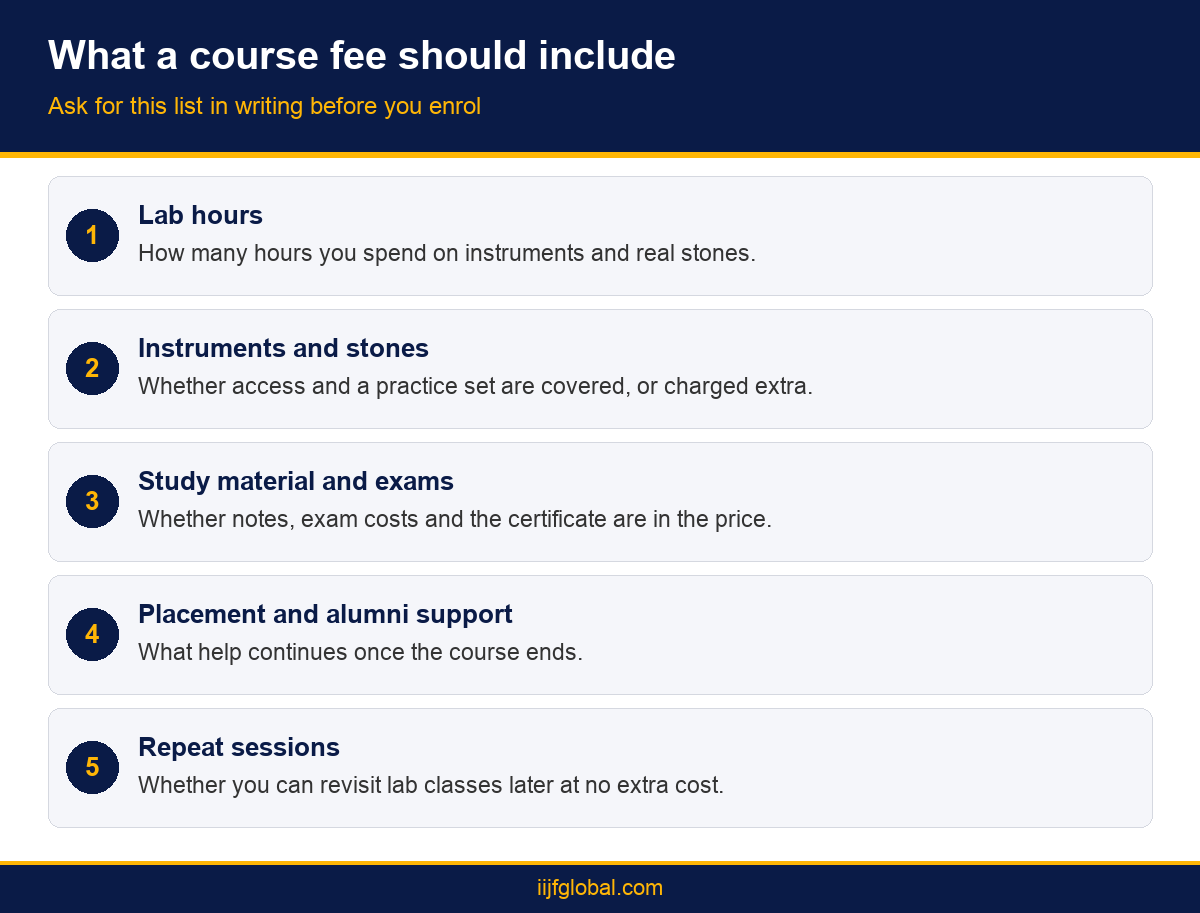
A fair fee should cover more than a few lectures. Ask whether it includes lab hours, access to instruments and a set of practice stones. Check if study material, exam costs and a certificate are part of the price. Some institutes also include placement support and alumni access in the fee. When these are covered, the headline price gives you the full picture. When they are not, add the extra costs before you compare one course with another.
It also helps to ask about repeat classes and support after the course. Some institutes let you revisit lab sessions or refresh your skills later at no extra cost. Others offer guidance on jobs and appraisal work once you finish. These extras add real value that a low fee alone cannot match. Always ask for the full list of what the fee covers in writing, so there are no surprises once you enrol.
How to Get the Most Value From Your Fee
Once you pick a course, a few steps help you get full value from the fee. Attend every lab session, since practice is where skills grow. Handle as many stones as you can, and ask trainers to check your work often. Keep a record of the stones you study, so you build a portfolio to show employers. Use the alumni network to meet working gemologists and learn about jobs.
Plan your credentials in a smart order too. Start with a strong base course, then add a specialised path only when it builds on what you know. This avoids paying twice for the same skills. Ask your institute about placement support and make full use of it near the end of the course. When you treat the fee as the start of a career, not just a class, the money you spend returns far more in the long run.
Conclusion
A gemology course in India suits many budgets and schedules. Certificates offer a quick, low cost start, while diplomas and degrees add depth for a full career. With open eligibility and strong demand, the fee often returns real value. Choose a route that fits your goal, then confirm the fees, duration and lab time before you enrol. Explore the programmes at IIJF Global to find the right fit for you.
Frequently Asked Questions
How much does a gemology course cost in India?
Gemology course fees vary by type. Short certificates often start near thirty thousand rupees, while diplomas cost more for extra lab time. Degrees sit at the higher end due to their length.
How long is a gemology course?
A certificate takes three to six months. A diploma runs six to twelve months with more lab work. A degree takes two to three years. Hybrid options can spread study over a longer period.
What is the eligibility for a gemology course?
Most gemology courses need only a pass in class ten or class twelve. There is no age limit, and no science background is required, since trainers teach the science from the start.
Do gemology course fees include instruments and stones?
Not always. Some fees cover stones and instruments, while others charge extra. Always confirm what is included before you enrol. Check the course details for a clear breakdown.
Is a gemology course worth the money?
For most learners, yes. Trained gemologists earn more than untrained staff and can add appraisal income. The skill lasts for life, and demand in the jewellery trade stays strong.
Can I do a gemology course after class ten?
Yes. Many gemology courses accept a class ten pass. This makes gemology accessible to young learners who want an early, practical entry into the jewellery trade.
Are there part time or hybrid gemology courses?
Yes. Many institutes offer hybrid and part time formats. You study theory online and attend campus for lab work, which suits working professionals and learners in other cities.
Which gemology route gives the best jobs?
A diploma usually gives the best job outcomes, since it adds deep lab training. To plan your career, read this guide on becoming a gemologist in India.
Does a gemology course include diamond grading?
Yes. Most gemology courses include diamond grading using the four Cs. You can also study a focused diamond grading path to specialise further in diamonds.
Where can I compare gemology course fees?
Compare fees directly with two or three institutes and check what each fee includes. Look at lab time, trainers and placement support, not just the headline price, before you decide.

You may also like

Jewellery CAD Design Course: Skills, Software and Scope

Certified Gemology Training Institute: How to Choose One
