
Jewellery Making Course: Types, Skills and How to Choose
A jewellery making course can lead to very different places: a weekend hobby, a small home business or a paid seat at a goldsmith’s bench. The right choice depends on which of those you want, because each route teaches different skills with different tools. This guide compares the four main routes, explains what to check before you pay, and covers the gold basics every maker needs. It closes on stone knowledge, the part of the craft that IIJF’s gem and diamond diplomas address.
Key Takeaways
- A jewellery making course falls into one of four routes: precious metal bench work, handmade, artificial or beadwork. Choose by outcome first.
- Gold jewellery making courses should cover purity and hallmarking, because both affect what you can honestly make and sell.
- Judge jewellery making training by bench time, batch size and sample work, then add stone knowledge to protect your margins.
What a Jewellery Making Course Covers: Four Routes
Most jewellery making courses in India fall into four routes, and they differ more than the shared name suggests. Two work with metal and heat. Two work mainly with assembly, thread and ready components. Knowing the route saves money, because a beadwork class and a goldsmith apprenticeship share little beyond the word jewellery. The graphic below sets them side by side.
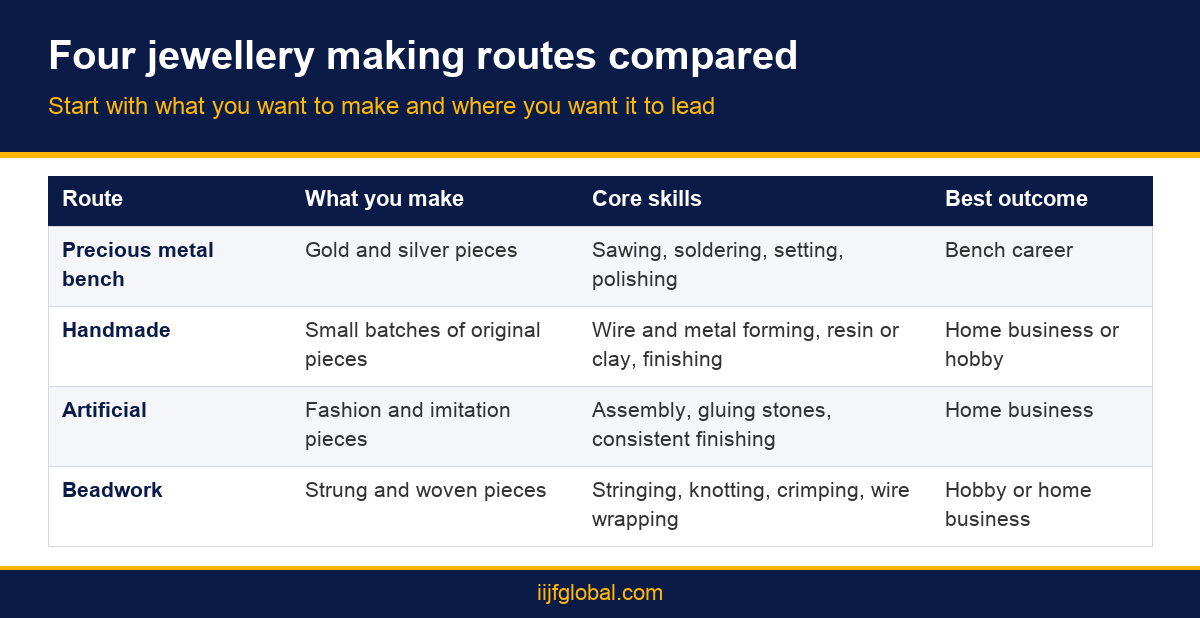
Precious metal bench work
This is the craft of the goldsmith and silversmith. You saw, file, shape, solder and polish real metal at a workbench. Gold jewellery making courses sit in this route, as do silver classes, which many beginners take first because mistakes cost less. It is the slowest route to learn and the most direct path to employment at a jeweller’s bench.
Expect training in cutting sheet and wire, forming, joining, finishing and basic casting. Some programmes add lost-wax casting, where a wax model is burnt out of a mould and replaced with molten metal. Ask early whether you will work in real silver or gold, or only in copper and brass. Practice metals are normal at first, but the behaviour of gold differs.
Handmade jewellery
A handmade jewellery making course sits between craft and bench work. It usually uses silver, copper, brass, wire, resin or polymer clay, and it teaches small batches of original pieces. Tools are lighter and the setup can fit a home table, although some classes still use a small torch. This route suits makers who care about design and want distinctive work.
Artificial jewellery
An artificial jewellery making course focuses on costume jewellery, also called fashion or imitation jewellery. You work with base metal findings, glass stones, adhesives and ready components. Little heat is involved, and the cost of a mistake is low. The commercial skills are speed, consistent finishing and spotting what customers want to buy this season. It rewards a good eye for trends.
Beadwork
A beads jewellery making course teaches the craft of beadwork: stringing, knotting, wire wrapping, crimping and simple loom work. It is usually the cheapest and fastest route to a finished necklace, and many hobby classes start here. Beadwork also rewards knowledge of materials, because a natural stone bead and a dyed or glass imitation can look alike on the strand.
Skills and Tools by Route, From Soldering to Stone Setting
Skills decide what you can make, so read the syllabus of any jewellery making course before you read its brochure. The table below shows what each route usually teaches and the tools you will meet. Treat it as a typical pattern, because individual classes vary. A short workshop may cover one or two skills, while a full programme builds them in sequence.
| Route | Core skills | Main tools |
|---|---|---|
| Precious metal bench | Sawing, filing, forming, soldering, setting, polishing | Bench pin, jeweller’s saw, files, torch, pliers, polishing motor |
| Handmade | Wire forming, simple metal work, resin or clay work, finishing | Pliers, hand files, small torch, moulds, curing or baking kit |
| Artificial | Assembly, gluing stones, findings, plating awareness, packing | Round and flat nose pliers, adhesives, tweezers, findings |
| Beadwork | Stringing, knotting, crimping, wire wrapping, loom work | Bead boards, thread, wire, crimping pliers, bead looms |
Metal skills: sawing to soldering
Bench students begin with control. You learn to saw a clean line, file a true edge and bend wire evenly. Then comes joining metal with a melted filler, the skill most beginners find hardest. Heat must reach the whole joint, and solder only flows where the metal is clean. Good jewellery making training lets you fail at this repeatedly on cheap metal first.
Stone setting
Setting means securing a stone in metal so it stays safe and shows well. Beginners usually start with a bezel, which wraps a metal rim around the stone, and then move to prongs. Pavé and other fine settings come much later and need a trained eye. Each stone behaves differently under pressure, which is why setters benefit from understanding what they are holding.
Setting is also where errors become expensive. A slipped tool can chip a stone or scratch a finished surface. So ask how many stones you will actually set during the course, and whether they are real or synthetic practice stones. A jewellery making course that only demonstrates setting will not leave you able to do it. Watching and doing are very different skills.
Assembly and finishing skills
Artificial and bead routes put their effort into assembly. You learn to choose thread or wire for the weight of a piece, finish a clasp neatly and keep a design consistent across a batch. Finishing matters on every route. Clean edges, secure joins and careful packing separate a saleable item from a craft project, and customers notice the difference quickly.
Hobby, Home Business or Bench Career: Which Outcome Fits You
Start with the outcome, then choose the jewellery making course that serves it. A hobbyist can enjoy a class that a future bench worker would find far too thin. A home seller needs costing skills that a hobby class rarely mentions. The three outcomes below need different levels of skill, money and patience, so be honest about which one you want.
Making as a hobby
If you want to make gifts and enjoy the process, keep the commitment small. A beadwork or wire class is enough to start, and an online jewellery making course can work well because assembly is easy to follow on video. Search for jewellery making courses near me only when you want in-person feedback. Buy a basic tool kit, and upgrade after you know you will keep going.
Running a home business
A home business needs repeatable products, sensible pricing and steady sales. Artificial, bead and handmade routes suit this best, since they need less equipment and lower material stock. Choose a jewellery making course that covers costing, sourcing and photographing your work. You will also need basic selling knowledge, and IIJF’s retail sales diploma shows what structured training on that side of the trade looks like.
Describe your materials honestly from your first sale. Call imitation pieces imitation, name plated metal as plated, and do not describe a coloured glass bead as a gemstone. Customers trust sellers who explain what they are buying. If you plan to sell gold, read the hallmarking section below before you price anything, because selling precious metal brings rules that a craft stall does not face.
Working at the bench
A bench career takes the longest and asks the most. You will need real precious metal experience, speed, accuracy and the patience to repeat small tasks well. Employers such as manufacturers and jewellers’ workshops will judge what your hands can do, so a good portfolio can matter more than a certificate. Choose a jewellery making course with heavy bench time and strong trade contacts.
Younger learners can read about career pathways for school leavers to see how making fits beside other trade roles. Many bench workers still learn through apprenticeship under an experienced craftsman, sometimes after finishing formal classes. A jewellery making course can shorten that early stage, but expect to keep learning for years after it ends. Speed and fine setting arrive only with sustained practice.
The table below sums up the three outcomes. Read it as a starting point, because your budget, your location and the time you can give each week may shift the answer. Some learners also move between outcomes. A hobby can grow into a small business, and a good home seller may later decide to train seriously at the bench.
| Outcome | Best routes | What to look for | Main demand on you |
|---|---|---|---|
| Hobby | Beadwork, wire, simple handmade | Friendly class, basic tool kit | Regular practice for enjoyment |
| Home business | Artificial, beadwork, handmade | Costing, sourcing, photographing work | Repeatable products, steady selling |
| Bench career | Precious metal bench work | Heavy bench time, trade contacts | Years of practice for speed and accuracy |
Gold Work Basics: Purity, Hallmarking and Why They Matter to Makers
Gold changes the stakes of every decision at the bench, so serious gold jewellery making courses teach purity and hallmarking alongside technique. A maker who misunderstands either can waste costly metal or mislead a customer. Even a hobbyist should know the basics before buying gold. These topics are short to learn and useful throughout a working life at the bench.
Purity: what karat and fineness mean
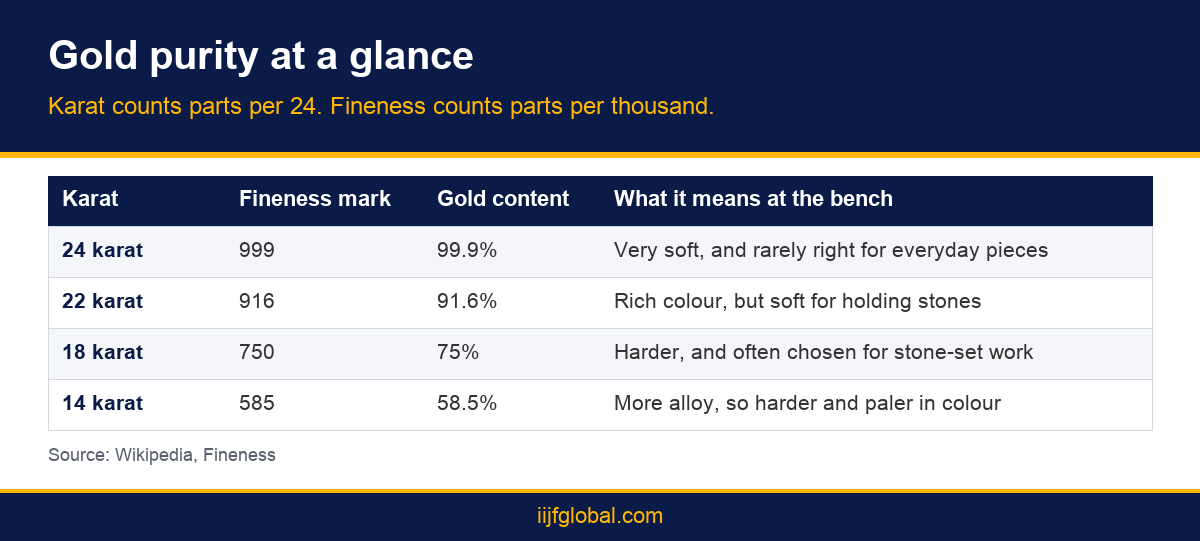
Karat measures gold in parts per 24, while fineness counts parts per thousand. So 22 karat gold is marked 916 and 18 karat gold is marked 750. Lower karats contain more alloy metal, which changes colour, hardness and working behaviour. A jewellery making course in gold should explain how alloys behave, and why solder must suit the metal it joins.
Why purity changes how you make
Purity is a making decision as well as a pricing one. Higher karat gold is soft, so it wears faster and holds stones less securely. The same fineness reference notes that stone-set work often uses lower karats, because the metal must be hard enough to hold the stone firmly. Choosing the right alloy for a design is therefore part of the craft.
Hallmarking: what makers should know
Mandatory hallmarking for gold jewellery in India is run by the Bureau of Indian Standards. Its overview of the hallmarking scheme explains how it works. BIS registers jewellers, and registered jewellers send pieces to a recognised assaying and hallmarking centre. The stated aim is to protect the public against adulterated gold and hold manufacturers to legal fineness standards.
For a small maker, three points follow. Know who will carry the registration before you sell gold pieces, since rules and exemptions change and BIS publishes the current position. Buy metal from suppliers who document its purity. Keep records of what goes into each piece. A customer can also get hallmarked jewellery tested at a recognised centre for a fee, so accuracy is not optional.
Learn how buyers check your work as well. Reading about hallmark, invoice and setting checks shows the questions a careful customer now asks. Those same questions make useful quality checks at your own bench. If your jewellery making training never mentions documentation, plan to cover that gap yourself before you take orders for real gold pieces.
How to Judge a Jewellery Making Course Before You Pay
Brochures look alike, so test every jewellery making course against the same questions. Hours of real practice, batch size, trainer background and sample work tell you more than a syllabus list. Ask each question in writing and compare the replies. A good provider answers them easily. Vague answers about bench time or materials are a useful warning before any money changes hands.
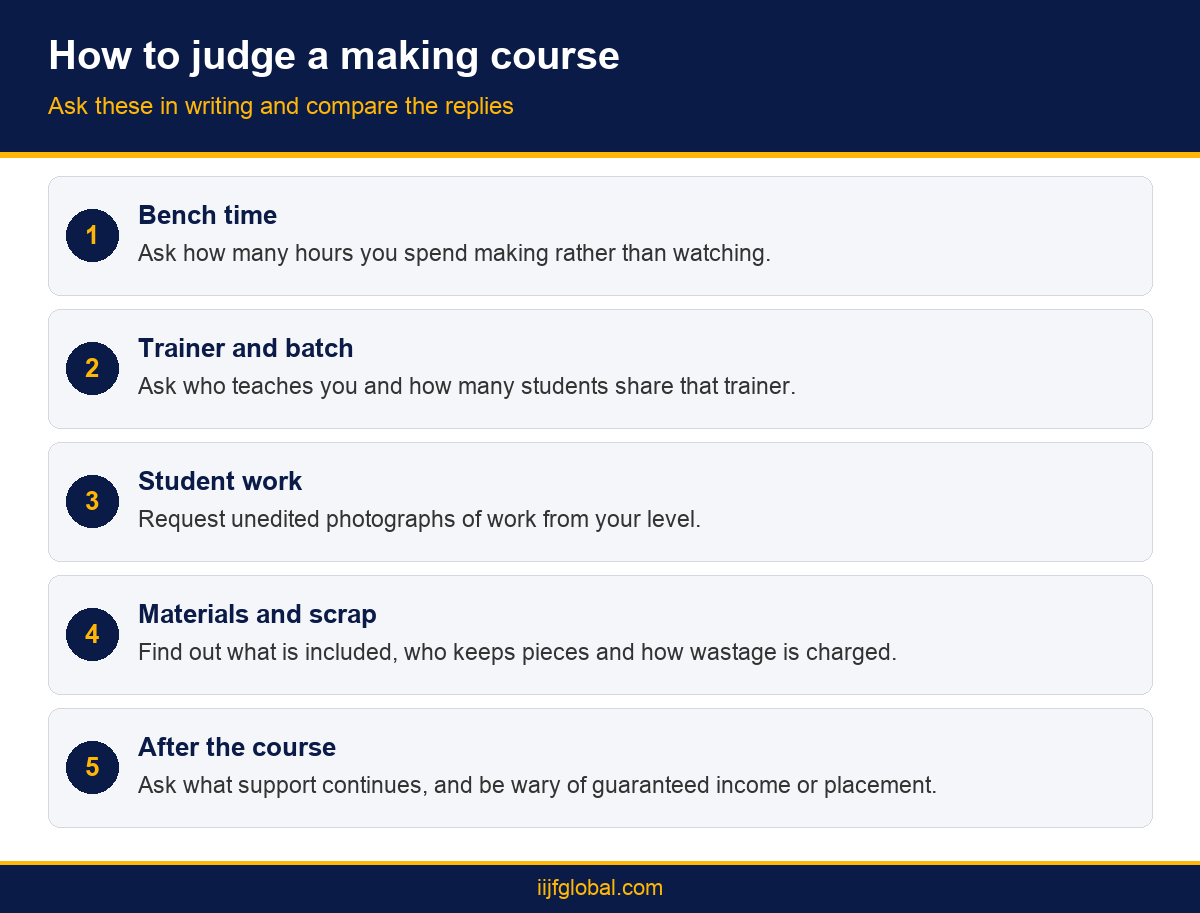
Bench time comes first. Ask how many hours you spend making rather than watching, and how many students share one trainer. Then ask who trains you, and whether they have worked in the trade or only teach. Request photographs of unedited student work from the same level you are joining. A polished trainer sample tells you little about what learners actually achieve.
Check materials and ownership next. Find out whether metal, stones and tools are included, and whether you keep what you make. A cheap jewellery making course can become expensive if every practice piece is billed separately. Also ask what certificate you receive, who issues it and whether anyone can verify it. For making, your finished work usually carries more weight than paper.
Location and format matter too. Searches for jewellery making courses near me are useful, because metal work needs a real bench and a trainer watching your hands. Visit before you pay. Look at ventilation, torch safety, the condition of the tools and the space per student. An online jewellery making course suits beads and assembly far better than it suits soldering.
Read the syllabus for sequence as well as content. Skills should build in order, from control of the saw to joining and then to setting. A class that jumps to a finished ring on the first day may be selling an experience rather than teaching a skill. Experiences are fine for a hobby, but they will not prepare you for paid work.
Safety deserves its own question, especially on metal routes. Torches, polishing motors and pickling chemicals can all cause injury when handled carelessly. Ask what protective equipment is provided, how students are supervised and what you are taught about fumes and fire. A trainer who takes safety seriously usually runs an organised bench in other ways too.
Ask what happens after the course as well. Some providers connect students with workshops or suppliers, while others stop at the last class. Be careful with any promise of guaranteed income or placement, especially on a short programme. Honest jewellery making training describes the support on offer and the effort you will still need to invest after it ends.
Jewellery Making Course Costs and Time
Fees for a jewellery making course vary widely, and few providers publish comparable figures. The design side offers one rough signal. Collegedunia’s course overview lists average jewellery design course fees between INR 12,000 and INR 7,00,000. Making courses are a different product, so treat that only as evidence of how wide the Indian market is, and get written quotes.
| Route | Relative fee | Typical time to basic skill | Ongoing cost |
|---|---|---|---|
| Beadwork | Lowest | Days to a few weeks | Beads, thread, findings |
| Artificial | Low | Days to a few weeks | Stock, findings, packing |
| Handmade | Low to medium | Weeks to a few months | Metal, tools, small torch |
| Precious metal bench | Highest | Months, then years at the bench | Metal, workshop tools, wastage |
Those patterns reflect the materials more than the teaching. Bead and artificial classes use inexpensive stock and need little equipment. Silver and gold classes need ventilated benches, torches, polishing machines and metal that loses value when wasted. Gold jewellery making courses therefore carry the largest material risk. Ask whether metal is included, who keeps the scrap and how wastage is charged.
Budget beyond the fee. A home setup needs a tool kit, materials and some early pieces that will not sell. A business adds photography, packaging and selling costs. Bench learners may also need to travel, or live near a training centre or workshop. Add these items before comparing two options, because the cheaper jewellery making course is not always the cheaper path.
Ask how the fee is structured, too. Some providers charge per session, some per module and some for a whole programme with materials included. Others sell a kit separately, and a kit may hold more tools than a beginner needs. Compare the total cost of reaching one finished, saleable piece, because that number is far more useful than the headline fee.
Time follows the same pattern. Bead skills arrive quickly, while confident soldering and setting take sustained practice. Plan for practice between classes, since a jewellery making course only starts the habit. Learners with a day job can begin with evening or weekend sessions, then move to longer bench time once they know the route suits them. Starting small also limits your risk.
What Stone Knowledge Adds to Your Making
Technique shapes a piece, but the stones often carry its value. A jewellery making course may teach you how to set a stone without teaching you what that stone is. Makers often buy, price and describe stones on trust. That gap affects margins, customer confidence and the quality of the finished piece, and it is where gem training becomes useful.
Buying and pricing stones
Stone knowledge helps you buy with confidence. Learning the loupe, refractometer and polariscope helps you question a parcel rather than accept its label. Understanding cut, colour, clarity and carat helps you judge whether a diamond’s price makes sense. You also make better design choices, because you can match stone quality to the budget of the piece.
Setting safely
Stones respond differently to pressure and heat, and treatments can make them more fragile. Knowing about heat, dye and glass filling warns you which stones to handle with extra care at the bench. A filled stone may not survive what an untreated one would. That knowledge prevents expensive breakages, and it helps you explain a piece’s limits honestly to the buyer.
Describing stones honestly
Customers now ask sharper questions about what they are buying. A maker should understand India’s rule on what may be called a diamond before writing a product listing. Those selling traditional pieces should also know the nine stones and their common substitutes. Accurate descriptions protect your reputation when a buyer later seeks a second opinion.
IIJF teaches this side of the trade, not the bench itself. IIJF’s one-month grading diploma combines 20 hours of online theory with 20 hours of offline practicals, and is listed at Rs 1,50,000. IIJF’s two and a half month gemology diploma combines 60 hours of theory with 45 hours of practicals, and is listed at Rs 2,25,000.
Take a jewellery making course for your hands, and consider gem training for your judgement. The two fit together, and the order can follow your goal. Hobbyists may need only a short introduction, while anyone selling stone-set pieces will benefit from deeper study. IIJF also lists manual and CAD jewellery designing among its programmes, so contact the team for current batches if design interests you.
Conclusion
The best jewellery making course is the one that matches your outcome. Beadwork and artificial routes suit hobbies and small home businesses. Handmade work suits designers. Precious metal bench work suits people who want a trade. Judge every option by bench time, materials and student work, and learn gold purity and hallmarking early. Then close the gap most makers share, which is knowing their stones. To explore gem and diamond knowledge for makers, speak to the IIJF team and ask what is available now.
Frequently Asked Questions
Which jewellery making course is best for beginners?
Beadwork or a simple wire class suits most beginners, because tools and materials cost little and results come quickly. If you already know you want to work in gold, start with silver bench classes, then move on to precious metal once your control improves.
Does IIJF offer a jewellery making course?
IIJF’s published programmes centre on gems, diamonds, forensics, retail and design rather than bench making. Readers can see who IIJF is and what it teaches, then ask the team what is currently available and how gem knowledge could support their making.
How do I find good jewellery making courses near me?
Shortlist local providers, then visit each one before paying. Check the benches, tools, ventilation and batch size, and ask to see unedited student work. Trade associations, local jewellers and working craftspeople can often tell you which classes actually produce capable makers in your city.
Can I learn jewellery making online?
Beadwork, wire work and artificial assembly can be learned well online, since the steps are easy to follow on video. Soldering and stone setting are harder to learn remotely, because they involve heat and fine control. A trainer watching your hands catches mistakes much faster.
Do I need a degree or qualification to become a bench jeweller?
Employers usually care most about what your hands can produce, so a strong portfolio carries real weight. Formal training still helps, as it gives you structure and contacts. Many bench workers keep learning through apprenticeships or on the job for years.
What should jewellery making training cover for gold?
It should cover karat and fineness, alloy behaviour, suitable solders, wastage control and hallmarking. You should also learn to document metal purity and buy from reliable suppliers. Without these basics, a skilled maker can still waste costly metal or misdescribe a piece.
Do I need a licence to sell handmade gold jewellery in India?
Hallmarking for gold jewellery runs through the Bureau of Indian Standards, which registers jewellers and recognises hallmarking centres. Rules and exemptions change over time, so check the current BIS position, and take professional advice for your own case, before you start selling any gold pieces.
Can I start a home business after a short course?
Yes, particularly with bead, artificial or simple handmade products, though a short class only gives you the basics. You will still need practice, consistent finishing, realistic costing and honest descriptions. Start with small batches, test what sells, and buy costly tools later.
Why should a jewellery maker study gemstones?
Makers buy, set and describe stones every day. Gem knowledge helps you avoid overpaying, handle treated stones safely and answer customers accurately. If you later want this as a profession, read the steps into the profession to see what serious training usually involves in India.

You may also like

Jewellery CAD Design Course: Skills, Software and Scope

Gemology Course Fees, Duration and Eligibility in India
