
Best Diamond Grading Course for Beginners: 8 Checks
Choosing the best diamond grading course for beginners is harder than it looks, because most brochures promise the same things. Fees, hours and certificates are easy to list. What matters more is how long you spend grading stones yourself, and who corrects your work. This guide gives you eight checks to apply to any institute, plus the questions to ask before you pay. It is a buyer’s checklist, not a ranking. If you are still weighing up the career itself, start with the steps into the profession.
Key Takeaways
- Judge a diamond grading course on bench hours, master colour sets, plotting practice and clear examination details.
- No prior experience means no gem knowledge is assumed. It does not mean the standard is lower.
- IIJF’s published format is one worked example: 20 hours of theory online and 20 hours of practicals offline.
Who Is the Best Diamond Grading Course for Beginners Really For?
In short: a beginner is anyone who has never graded a loose stone, including students, career switchers and family jewellers. No prior experience should mean that no gem knowledge is assumed on day one. It should not mean the course stays easy. You still have to practise until your grades match your trainer’s.
Family jewellers are often beginners too. Someone may have sold diamonds for years and never plotted a stone or sat with a master set. That person has strong trade knowledge but little grading practice. A school leaver is a beginner, and so is a working professional changing careers. Their starting points differ, yet the first need is the same: a structured route through the four factors every grader assesses, with supervised time on stones.
Read the phrase “no prior experience” carefully. A fair course starts with how diamonds form, then builds up to the grading factors. It explains terms before using them and lets you make mistakes on stones with known grades. IIJF’s Diploma in Diamond Grading, for example, lists its skill level as all levels and opens with formation and crystallography. Ask any institute what the first week looks like. A clear answer shows whether beginners were considered in the design of the course.
Checks 1 to 3: Real Stones, Master Sets and Tools
In short: grading is a visual skill, so the first three checks test your access to physical material. Ask how many hours you spend on real stones, whether a master colour set is used, and which tools are supplied. Theory can be taught online. Practice on diamonds cannot, so these three checks carry real weight.
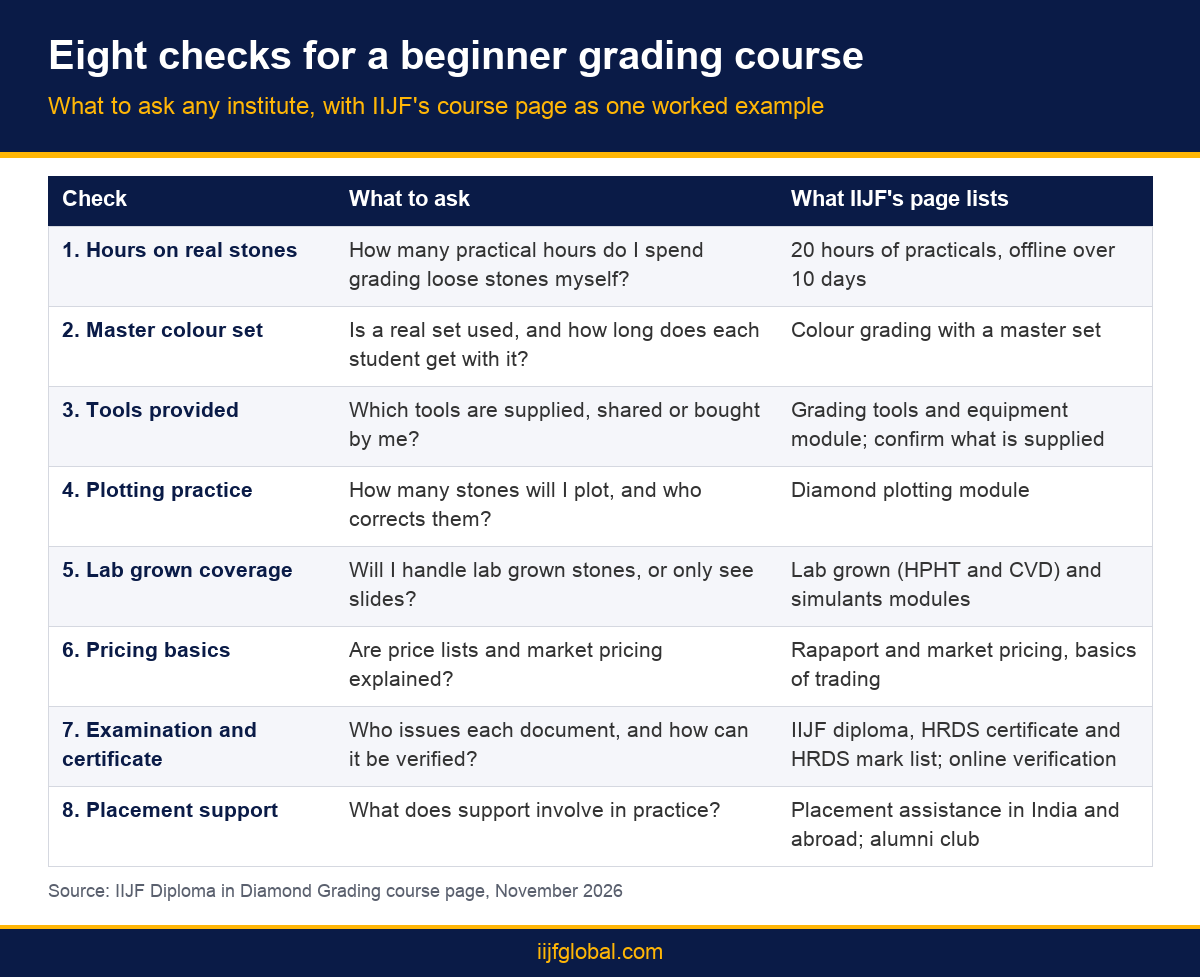
Check 1: hours on real stones. Ask for the split between theory and practicals, then ask how many practical hours you spend grading loose stones yourself. Demonstrations and group viewing should not count. As one worked example, IIJF’s one-month grading diploma lists 20 hours of theory, online at one hour a day for 20 days. It also lists 20 hours of practicals, offline at two hours a day for 10 days. Compare other schedules against a published split like this one.
Check 2: a master colour set. Colour is graded by comparison, and the D to Z colour scale depends on master stones viewed in controlled lighting. A photograph cannot replace that. Ask whether the course uses a real master set, how many stones it holds and how long each student gets with it. Retail graders often work with a subset of about five stones, so a small set can still be useful.
Check 3: tools provided. Find out which instruments are supplied in class, which are shared and which you must buy. A short guide to what each instrument actually does will help you judge the list. IIJF names grading tools and equipment as a module, so confirm what is supplied when you enquire. Ask the same question of every institute you shortlist.
Checks 4 to 6: Plotting, Lab Grown Coverage and Pricing
In short: these three checks separate a course that teaches you to describe a diamond from one that prepares you for trade work. Look for plotting practice on real stones, proper lab grown coverage and a grounding in how pricing works. Each one should appear by name in the syllabus you are given before enrolling.
Check 4: plotting practice. A plot is a map of a diamond’s inclusions and blemishes, drawn on a diagram of the stone. It forces you to find each feature and then record it accurately. Ask how many stones you will plot and whether a trainer corrects each one. A single plot shown on a slide is not practice. Ask to see a sample plot from a past student, with names removed.
Check 5: lab grown coverage. The syllabus should name the two main production methods, HPHT and CVD. Ask whether you will handle lab grown stones or only see them in slides. Check that simulants and treatments are covered too, along with India’s rule on what may be called a diamond. That rule shapes how you describe a stone to a buyer, so it belongs in a beginner’s training.
Check 6: pricing basics. A grade has limited use if you cannot connect it to a price. Ask whether the course explains the Rapaport list, how market prices differ from it and how buying and selling work. IIJF’s module list, as an example, names plotting, HPHT and CVD, simulants, Rapaport and market pricing, the basics of trading and grading mounted diamonds. Use a published list like that when you compare syllabi.
Checks 7 and 8: Examination, Certificate and Placement Support
In short: the last two checks test what you walk away with. Ask how you are assessed, who issues each document and how an employer can verify it. Then ask what placement support involves in practice. Good answers are specific, written down and easy to confirm. Vague promises about jobs deserve extra caution from any beginner.
Check 7: examination and certificate. Ask whether the assessment includes grading stones you have not seen before, or only a written test. Then ask who issues each document. At IIJF, students earn a Diploma Certificate from IIJF, an Accredited Course Completion Certificate from HRDS and a Mark List from the Board of Examinations, HRDS. Certificates can be checked on IIJF’s certificate verification page. Wherever you enrol, confirm that a similar verification route exists.
Check 8: placement support. No honest institute can promise you a job, so treat any guarantee as a warning sign. Ask what support involves: introductions, interview preparation, an alumni network or job listings. IIJF lists placement assistance in India and abroad, plus alumni club membership, among its student benefits. Treat support of this kind as help with access. Your grading accuracy still has to carry the interview.
What to Ask Before You Pay for a Diamond Grading Course
In short: turn the eight checks into direct questions and ask for the answers in writing. A few short messages will tell you more than a brochure. Compare fees only after comparing practical time, materials and assessment, because a lower price can hide extra costs once travel, tools and visits are added.
Start with money. Ask what the fee covers and what costs extra. IIJF’s grading diploma, for instance, is listed at Rs 1,50,000 against a list price of Rs 2,00,000, and its factory and diamond market visits are additionally payable. Then ask about batch timing, the practical venue and language. IIJF offers its courses in English, Malayalam, Tamil, Hindi, Kannada and Telugu, which can help if technical terms are easier in your own language.

Next, test how the course runs day to day. Ask how many students share one set of stones, who corrects your plots and what happens if you miss a practical session. Ask for the refund terms in writing. The best diamond grading course for beginners should answer all of this without pressure. Slow or evasive replies at this stage tell you something useful, too.
Conclusion
The best diamond grading course for beginners is the one that passes these eight checks on your terms: real stones, a master set, clear tools, plotting, lab grown coverage, pricing, a verifiable certificate and honest placement support. Put your questions in writing and compare the answers side by side. Use IIJF’s published format as one reference point among the options you review. To go through these checks against a current batch, speak to the IIJF team about practical schedules, languages and fees, then decide with the answers in front of you.
Frequently Asked Questions
What is the best diamond grading course for beginners?
There is no single answer for every learner. The right choice gives you supervised hours on real stones, a master colour set, plotting practice, lab grown coverage, pricing basics, a verifiable certificate and honest placement support at a fee you can manage.
Do I need prior experience to join a diamond grading course?
Usually a beginner course assumes no gem knowledge, but check the entry terms of each institute. IIJF’s Diploma in Diamond Grading lists its skill level as all levels. You will still need patience, steady practice and time set aside for the practical sessions.
How long does a beginner grading course take?
Durations vary by institute and depth, so compare total hours as well as months. IIJF’s Diploma in Diamond Grading runs for one month, with 20 hours of theory online and 20 hours of practicals offline. Ask how the practical hours are actually spent.
Can diamond grading be learned fully online?
Theory travels well online, including formation, the grading factors and report reading. Colour grading and plotting need physical stones and a trainer who checks your results. That is why IIJF teaches its grading theory online and runs its practical sessions offline. Plan your travel accordingly.
Why does a master colour set matter for beginners?
Colour grades are assigned by comparing a stone against master stones in controlled light. Screens and printed charts cannot reproduce that comparison. Time with a real set trains your eye, so ask how many stones the set holds and how long you get with it.
What should a beginner course teach about lab grown diamonds?
It should name HPHT and CVD, explain how these stones differ from natural diamonds, and cover simulants and treatments as well. Ask whether you will handle samples in class. Graded practice on real samples is far more useful than slides for a new learner.
What documents do students earn from IIJF’s grading diploma?
Students earn a Diploma Certificate from IIJF, an Accredited Course Completion Certificate from HRDS and a Mark List from the Board of Examinations, HRDS. Certificates can be verified online. Before enrolling anywhere, ask who issues each document and how an employer can confirm it.
Does a grading course guarantee a job?
No honest course can guarantee one, so be careful with any such promise. IIJF lists placement assistance in India and abroad among its benefits. Ask any institute what that support includes, then compare it across the programmes listed by IIJF and other options.
Should a beginner choose grading alone or a wider diploma?
Choose grading alone if your work centres on diamonds. Choose wider training if you also expect to handle coloured stones. IIJF’s combined diamonds and gemstones diploma is one such option. Compare its practical hours and fee with the single subject route first.

You may also like

Jewellery CAD Design Course: Skills, Software and Scope

Gemology Course Fees, Duration and Eligibility in India
