Fake Jewellery Red Flags: Hallmark, Stamp, Invoice and Setting Checks
Fake or misrepresented jewellery rarely looks fake at first glance. It looks almost right. The colour is close, the weight feels fair and the shop sounds confident. The difference shows up in small details that a trained eye checks every time. This guide walks through the fake jewellery red flags that matter most, from the hallmark and stamps to the invoice and the way stones are set.
Key Takeaways
- In India, a genuine BIS hallmark on gold jewellery carries three marks, and the six digit HUID can be checked in minutes.
- Stamps, invoices and settings each tell a story, and a mismatch between them is often the first warning sign.
- These checks reduce risk, but only proper testing confirms a piece, which is why forensic training matters.
Why Small Details Reveal Fake Jewellery
Counterfeit and misrepresented jewellery is built to pass a quick look. Plated metal can match the colour of gold. Glass can sparkle under shop lights. A stamp can be punched onto almost anything. What a faker cannot easily match is consistency across every detail at once.
That is the core idea behind jewellery forensics. Instead of trusting one sign, you compare many. Does the hallmark match the invoice? Does the weight match the size? Does the setting suit the stone it claims to hold? When the answers disagree, you slow down and test further.
These habits protect buyers, but they matter even more for people who work in the trade. A store that accepts a fake piece in an exchange, or a valuer who misses a swapped stone, carries the loss and the damage to trust.
Check the BIS Hallmark and HUID First
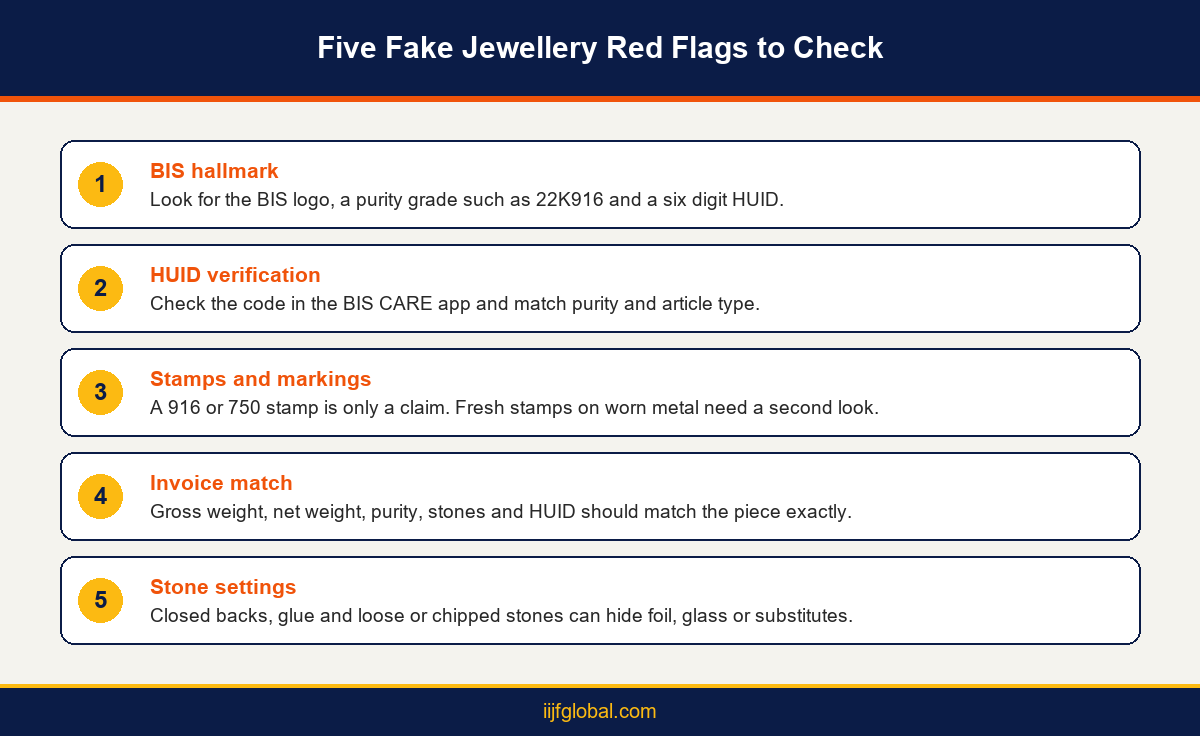
For gold jewellery sold in India, the hallmark is the strongest first check. A current BIS hallmark has three parts. The first is the BIS logo. The second is the purity grade, such as 22K916 for 22 carat or 18K750 for 18 carat. The third is the HUID, a six digit alphanumeric code unique to that piece.
Since April 2023, gold jewellery sold with a hallmark must carry the HUID. Older marks without it, such as a jeweller’s own logo or an assaying centre mark, belong to earlier rules. A new piece without a HUID is a red flag worth questioning.
The HUID can be verified through the “Verify HUID” option in the BIS CARE app from the Bureau of Indian Standards. The app shows details such as the purity and the article type recorded at hallmarking. If the record says ring and you are holding a chain, or the purity does not match the mark, stop there.
Read Stamps and Markings With Care
Many pieces also carry stamps such as 916, 750, 925 or KDM. On their own, these numbers prove very little. Anyone can buy a stamping punch, so a stamp is a claim, not evidence.
Look at how the stamp sits on the metal. Genuine marks are usually crisp and even. Shallow, uneven or doubled stamps can suggest a mark added later. Check that the stamp matches the metal colour and wear around it. A heavily worn piece with a sharp, fresh stamp deserves a second look.
Also watch for terms that sound official but mean little, such as “gold finish”, “one gram gold” or “GP”, which often signal plating. Plated pieces may show a different colour at edges, clasps and high wear points where the top layer has rubbed away.
Match the Invoice to the Piece
A proper invoice is a forensic record. A good one lists the gross weight, the net weight of metal, the purity, the weight and type of any stones, the making charges and the HUID of each hallmarked piece. Vague invoices that show only a total price make later disputes hard to settle.
Compare the invoice line by line with the piece. If the invoice says 8 grams net and the piece weighs noticeably less, ask why. If stones are listed as diamonds but no weight or quality appears, ask for details in writing. For diamonds and gemstones of real value, a grading report should match the stone, a skill covered in our guide on how to read a diamond certificate.
Inspect Stone Settings Closely
Settings hide many tricks. Closed back settings can conceal foil behind glass, which boosts sparkle in a way real gems do not need. Stones held mainly by glue, rather than secure prongs or bezels, may suggest a low cost substitute. A stone that rattles, sits crooked or shows glue residue around its edge is a warning sign.
Use a 10x loupe to look at the prongs and the stone’s girdle. Real diamonds and quality gems are usually set with care, because the stone justifies it. Look for chips, scratches or rounded facet edges, which can point to softer simulants such as glass. A structured diamonds and gemology diploma teaches how the loupe fits into a full testing kit.
Weight, Feel and Simple Screening
Gold is dense, so a piece that feels light for its size can be hollow, filled or plated base metal. A sensitive scale gives a better answer than your hand. Gold is also not magnetic, so a strong pull from a magnet is a warning sign, though a lack of pull does not prove a piece is gold.
Treat these as screening steps, not final answers. Shops and labs use proper methods such as XRF testing for metal purity and gemological instruments for stones. A screening check tells you when to send a piece for testing. It never replaces the test itself.
When to Send a Piece for Testing
Send a piece for professional testing when the hallmark is missing or does not verify, when the invoice and the piece disagree, when a setting looks suspicious, or when the value is high enough that a mistake would hurt. Stores should build this into their buying and exchange process rather than deciding case by case.
This is exactly the work a trained forensic professional does every day. If you want to build these skills for a career or for your store team, the Diploma in Jewelry Forensics covers metals, hallmark verification, stone identification and documentation in one structured course.
Conclusion
Fake jewellery rarely fails one big test. It fails many small ones. Check the BIS hallmark and HUID, read stamps with doubt, match the invoice to the piece and inspect every setting under a loupe. When details disagree, test before you trust. To learn these checks properly with real pieces and expert trainers, explore IIJF Global’s jewellery courses or contact our team.
Frequently Asked Questions
Q1: What are the most common fake jewellery red flags?
A missing or unverifiable HUID, stamps that look added later, an invoice that does not match the piece, glued or closed back settings and a weight that feels wrong for the size are the most common warning signs.
Q2: What should a BIS hallmark on gold jewellery include?
A current BIS hallmark has three parts: the BIS logo, the purity grade such as 22K916, and a six digit alphanumeric HUID that is unique to that piece of jewellery.
Q3: How do I verify a HUID number?
Use the Verify HUID option in the BIS CARE app. Enter the six digit code and check that the purity and article type shown match the piece in front of you.
Q4: Does a 916 stamp prove that jewellery is 22 carat gold?
No. A stamp is only a claim, since anyone can buy a stamping punch. Rely on a verified BIS hallmark with HUID, and send doubtful pieces for proper testing.
Q5: Can a magnet tell me if jewellery is real gold?
Gold is not magnetic, so a strong pull is a warning sign. However, many base metals are not magnetic either, so the magnet test can only screen, not confirm, a piece.
Q6: What should a jewellery invoice show?
A good invoice lists gross weight, net metal weight, purity, stone type and weight, making charges and the HUID of each hallmarked item, so it can be checked against the piece later.
Q7: Why are closed back settings a concern?
Closed back settings can hide foil behind glass or low quality stones to boost sparkle. They are not always fake, but they deserve closer inspection and testing.
Q8: Is home testing enough to confirm jewellery is genuine?
No. Home checks only screen for problems. Proper confirmation needs methods such as XRF testing for metal and gemological instruments for stones in a trained setting.
Q9: Who needs training in spotting fake jewellery?
Store staff, valuers, gemology students and jewellery business owners all benefit, because accepting a fake piece in sales or exchange directly costs money and customer trust.
Q10: Where can I learn jewellery forensics in South India?
IIJF Global offers a Diploma in Jewelry Forensics covering metals, hallmarks, stone identification and documentation, with online, offline and hybrid learning options.

You may also like