Fluorescence, Polish and Symmetry: Advanced Diamond Quality Factors Explained
Most buyers learn the 4Cs and stop there. Graders do not. A diamond report also lists fluorescence, polish and symmetry, and these details can change how a stone looks and what it is worth. Two diamonds with the same carat, colour, clarity and cut grade can still differ in price because of them. This guide explains each factor in simple terms and shows how professionals read them.
Key Takeaways
- Fluorescence describes how a diamond glows under ultraviolet light, graded from None to Very Strong.
- Polish and symmetry describe finishing quality and are graded from Excellent to Poor.
- These factors rarely matter alone, so graders judge them alongside the 4Cs and the stone in hand.
Beyond the 4Cs: Why These Factors Matter
Carat, colour, clarity and cut set the main quality of a diamond, as our guide to the 4Cs of diamond grading explains. But a diamond is also a finished product. How carefully it was polished, how evenly its facets line up and how it reacts to ultraviolet light all affect its final look.
For buyers, these factors explain why two similar looking certificates can carry different prices. For jewellers and graders, they are part of giving honest advice. A professional who can explain fluorescence or symmetry clearly earns trust that a sales pitch never can.
What Diamond Fluorescence Is
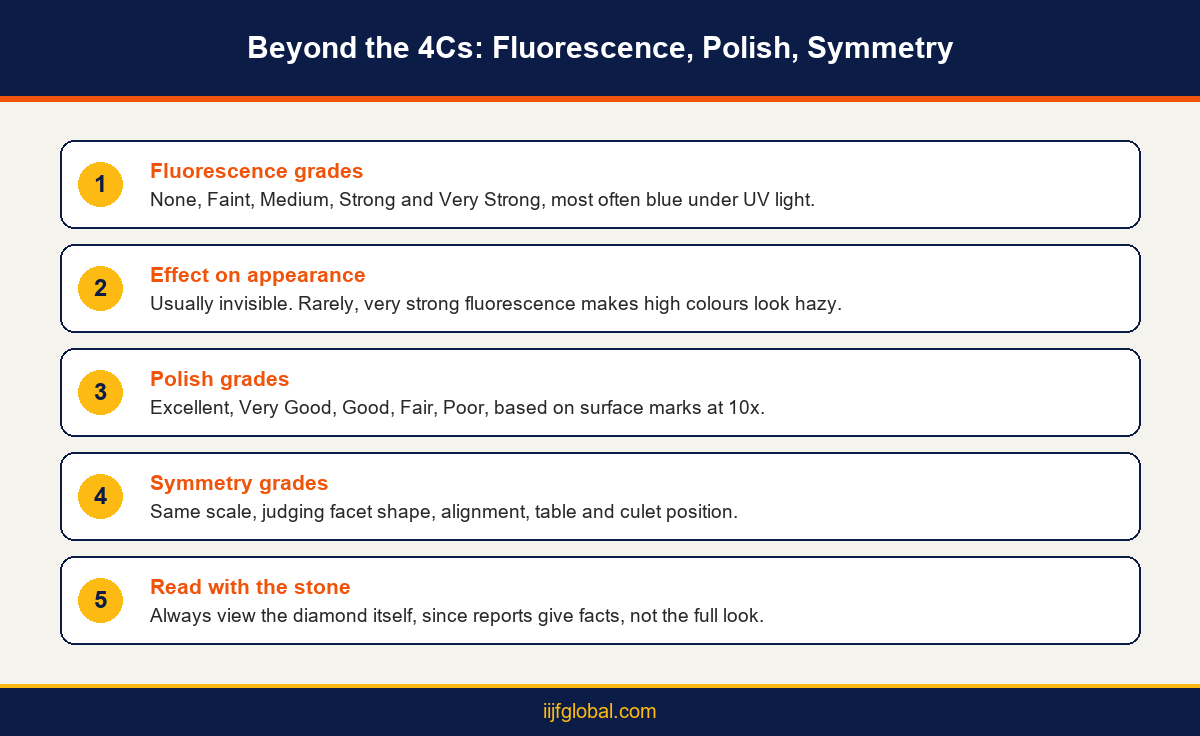
Fluorescence is the visible glow some diamonds give off under ultraviolet light, such as the UV in sunlight or a UV lamp. The most common colour is blue, though other colours occur. Many diamonds show at least some fluorescence, and graders record its strength on the report.
Labs such as GIA grade fluorescence as None, Faint, Medium, Strong or Very Strong. The report records strength, and colour where relevant. It is a description of a natural property, not a flaw. Some buyers even like the effect, while others prefer stones with none.
How Fluorescence Affects Appearance and Price
In most diamonds, fluorescence has no visible effect in normal lighting. In some cases, strong blue fluorescence can make a slightly yellowish diamond look whiter, which some buyers see as a benefit. In rare cases, very strong fluorescence in high colour diamonds can give a hazy or oily look.
Market price often reflects perception more than appearance. In higher colour grades, stones with strong fluorescence can trade at a discount. In lower colour grades, the effect on price may be small or even positive. This is why graders always look at the actual stone rather than judging fluorescence from the report alone.
Polish: The Quality of the Surface Finish
Polish describes how smooth and clean the diamond’s facet surfaces are after cutting. Small marks such as polish lines, burn marks, nicks or abrasions can appear during manufacture or wear. Graders examine the surface under 10x magnification and grade polish from Excellent to Very Good, Good, Fair and Poor.
Most polish features are tiny and invisible to the eye. Even so, poor polish can dull a stone slightly by scattering light at the surface. For most fine jewellery, Very Good or Excellent polish is common, and lower polish grades often signal a stone cut with less care.
Symmetry: How Precisely the Facets Align
Symmetry describes how exactly the facets are shaped, placed and aligned. Graders look for issues such as an off centre table or culet, misshapen facets, facets that do not meet neatly, and an outline that is not perfectly round on a round brilliant.
Symmetry is graded on the same scale as polish, from Excellent to Poor. Good symmetry helps light travel through the diamond as the cutter intended, which supports brightness and sparkle. For round brilliant diamonds, polish and symmetry are both considered within the overall cut grade on GIA reports.
Reading These Grades on a Diamond Report
On a grading report, fluorescence, polish and symmetry usually appear in a grading results or additional information section. Read them as part of the full picture rather than in isolation. A diamond with an excellent cut grade, very good symmetry and faint fluorescence is a very different proposition from one with poor symmetry and very strong fluorescence.
Always match the report to the stone, as covered in our guide on how to read a diamond certificate. Then view the stone yourself in different lighting. The report gives you facts, but the stone shows you how those facts combine.
Why Graders Need Training in These Factors
Explaining fluorescence, polish and symmetry well requires real experience with stones. A trained grader can tell when strong fluorescence actually affects a diamond’s look and when it does not. They can spot polish marks under magnification and judge symmetry with a practised eye.
These skills are part of a professional diploma in diamond grading, where students grade real stones, compare their results with reports and learn to explain their findings to customers. Industry bodies such as the Gem and Jewellery Export Promotion Council also stress the role of skilled grading in keeping trade standards high.
Conclusion
Fluorescence, polish and symmetry complete the story the 4Cs begin. Fluorescence describes a diamond’s glow under UV light, while polish and symmetry show how carefully it was finished. None should be judged alone, and the stone in hand always has the final say. To learn advanced diamond grading with real stones, explore IIJF Global’s diamond courses or contact our team.
Frequently Asked Questions
Q1: What is diamond fluorescence?
Diamond fluorescence is a visible glow, most often blue, that some diamonds show under ultraviolet light. Labs record its strength on the report from None to Very Strong.
Q2: Is fluorescence bad in a diamond?
Not necessarily. Most diamonds with fluorescence look normal in everyday light. Only in rare cases does very strong fluorescence make a high colour diamond look hazy, so view the stone itself.
Q3: Does fluorescence affect diamond price?
It can. In higher colour grades, strong fluorescence often trades at a discount. In lower colour grades, the effect may be small, since blue fluorescence can make a stone look whiter.
Q4: What does polish mean on a diamond report?
Polish describes the smoothness and finish of the facet surfaces. Graders check for polish lines, burn marks and nicks under 10x magnification and grade polish from Excellent to Poor.
Q5: What does symmetry mean on a diamond report?
Symmetry describes how precisely the facets are shaped and aligned, including the position of the table and culet and the roundness of the outline. It is graded from Excellent to Poor.
Q6: Do polish and symmetry affect sparkle?
Yes, to a degree. Poor symmetry can disturb how light travels through the stone, and poor polish can scatter light at the surface, both of which can reduce brightness slightly.
Q7: Which polish and symmetry grades should buyers look for?
Very Good or Excellent polish and symmetry are common in fine jewellery. Lower grades are not always a problem, but they deserve a closer look at the stone itself.
Q8: Are polish and symmetry part of the cut grade?
For round brilliant diamonds on GIA reports, polish and symmetry are considered within the overall cut grade alongside proportions and light performance.
Q9: Can I judge fluorescence from the report alone?
No. The report states strength, but appearance depends on the stone. Always view the diamond in daylight and indoor lighting before deciding whether fluorescence matters.
Q10: Where can I learn advanced diamond grading?
IIJF Global’s Diploma in Diamond Grading covers the 4Cs plus fluorescence, polish and symmetry, with practical grading of real stones.

You may also like